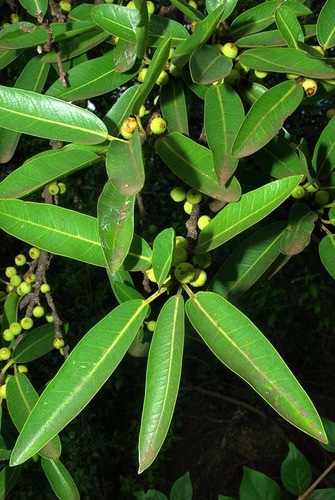
Wonderboom Fig
Ficus salicifolia
The Wonderboom Fig is a rocky-outcrop specialist that transforms harsh cliffs into thriving ecosystems. Known for its willow-like leaves and ancient growth habit, it is a magnet for every fruit-eating visitor in the neighborhood.
Quick Identification
Size
Typically reaches up to 10 m (33 ft) in height, with a spreading crown that can extend over 30 m (100 ft) in ancient specimens.
Colors
Greyish-brown bark with a smooth texture; dark green, glossy, lance-shaped leaves; small figs that turn from green to pinkish-red or spotted when ripe.
Key Features
- Narrow, willow-like (salicifolia) leaves with a distinct midrib
- Small, rounded figs roughly 5-10mm in diameter
- Aggressive, sculptural root system often found clinging to rocks
- Evergreen canopy providing dense shade year-round
When You’ll See Them
Behavior
The Wonderboom Fig is a resilient and culturally significant tree known for its ability to thrive in harsh, rocky environments. Unlike many other fig species that begin their lives as epiphytes (strangler figs), the Wonderboom is primarily a lithophyte, meaning it grows directly on rocks and cliffs. Its powerful root system can penetrate deep into stone crevices to find moisture, making it a master of survival in arid or high-altitude landscapes.
Ecologically, this tree acts as a vital 'pantry' for the neighborhood. It produces massive quantities of small figs that serve as a primary food source for a wide array of wildlife, from fruit-eating birds to monkeys and bats. In garden or suburban settings, it is a focal point of activity, though its growth is slow and steady, eventually forming a massive, leafy crown that can shade an entire backyard.
EverydayEarth exclusive
Camera Tips
Capturing the Wonderboom Fig is less about the tree moving and more about the incredible wildlife traffic it attracts. To get the best shots, position your camera to focus on the 'fruit zones'—the clusters of small figs that grow along the branches. Because these figs are small, a camera with a high-resolution sensor or a macro-focusing capability will help you capture the details of birds like African Green Pigeons or Barbets as they pluck the fruit.
For the best lighting, aim your camera north (if you are in the southern hemisphere) to ensure the sun is behind the lens for most of the day. The leaves are very glossy and can cause harsh glares in midday sun, so early morning and late afternoon provide the most flattering light for the tree's sculptural bark and deep green foliage. If your camera has a time-lapse feature, this is the perfect species for it; set it to take a photo every 15 minutes to document the ripening process of the fruit over several weeks.
Placement is key for animal interaction. Mount your camera about 5-8 feet up the trunk looking slightly outward toward a horizontal branch. Birds prefer landing on these 'runways' before moving toward the fruit. Avoid placing the camera too close to the ground, as the Wonderboom's dense shade can make the area under the canopy too dark for some sensors to trigger accurately. If you are using a trigger-based camera, set the sensitivity to high, as many of the visitors (like sunbirds and white-eyes) are small and move very quickly.
In a backyard setting, the Wonderboom is a permanent fixture. Use this to your advantage by creating a 'permanent' camera station. A sturdy tree strap or a screw-in mount is recommended, as the bark is tough and the tree doesn't sway significantly in the wind, providing a very stable platform for crisp, blur-free images. During the winter months, when other trees have lost their leaves, keep your camera active; the evergreen nature of this fig makes it the only green spot in many landscapes, concentrating all local bird activity into your frame.
Similar Species
Species that look similar or are commonly confused with Wonderboom Fig.
Frequently Asked Questions
Record Wonderboom Fig at your habitat
Connect a camera to start building your own species record — AI identifies every visitor automatically.