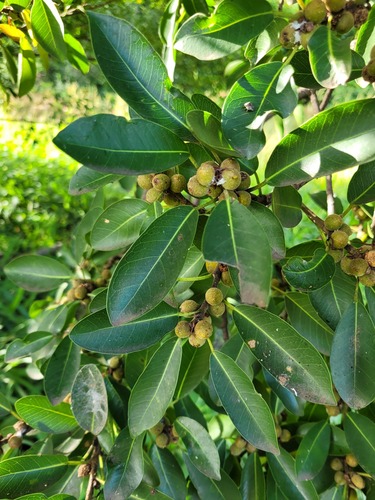
Common Wild Fig
Ficus burkei
A majestic keystone of the African wilderness, the Common Wild Fig is a 'living pantry' that sustains hundreds of species. Its massive spreading canopy and intricate aerial roots make it both a biological marvel and a stunning photographic subject.
Quick Identification
Size
Height of 10-25m (33-82ft) with a canopy spread often exceeding 30m (100ft)
Colors
Dark green glossy leaves, smooth silver-grey bark, and small figs that turn from green to yellow or red
Key Features
- Dense, rounded crown with dark green elliptical leaves
- Smooth, pale grey bark that often produces hanging aerial roots
- Small, stalkless figs (up to 1cm) produced in the leaf axils
- Milky white latex sap visible when leaves or twigs are broken
When You’ll See Them
Geographic range
Where Does the Common Wild Fig Live?
The Common Wild Fig is a signature species of the African continent, thriving across a vast range of Sub-Saharan environments. Its territory extends from the Eastern Cape of South Africa northward through Zimbabwe, Mozambique, and East African nations like Kenya, Tanzania, and Ethiopia. It is equally at home in coastal lowlands and high-altitude montane forests up to 2,500 meters.
Basemap © OpenStreetMap contributors
Behavior
The Common Wild Fig is a "keystone species" in African ecosystems, acting as a vital year-round food station for a vast array of wildlife. While it often begins its life as an epiphyte—germinating in the bark of a host tree and sending roots downward—it eventually grows into a massive, self-supporting tree. Its growth is vigorous and its root system is famously invasive, capable of cracking rocks or invading plumbing in search of moisture.
As a member of the Ficus genus, this tree has an incredible mutualistic relationship with tiny Agaonid wasps. Each fig species is pollinated by a specific wasp species that enters the fig through a tiny hole to lay its eggs. In exchange for pollination, the tree provides a nursery for the wasps. For humans, these trees are culturally significant across East Africa, where they are often preserved as sacred sites, meeting places, or living landmarks.
EverydayEarth exclusive
Camera Tips
The Common Wild Fig is perhaps the most productive location for a trail camera in any African backyard or wild space because it acts as a biological magnet. To capture the highest diversity of visitors, mount your camera on a sturdy branch looking toward a cluster of ripening figs. A height of 2 to 4 meters is ideal for capturing monkeys, squirrels, and fruit-eating birds like Turacos, Barbets, and Hornbills. If your camera has a wide-angle lens, use it to capture the scale of the canopy.
Because this tree attracts wildlife both day and night, set your camera to a "Hybrid" or "Smart" mode that takes high-resolution stills followed by short video clips. Video is essential for observing the complex social interactions of primates or the rapid-fire feeding behavior of fruit bats after dark. Keep in mind that the tree's dense foliage can create deep shadows even during the day, so ensure your camera is positioned to avoid direct lens flare while still having enough ambient light for clear shots.
If you are interested in ground-dwelling species like bushbuck, duiker, or even bushpigs, place a second camera at a lower height (about 0.5 meters) focused on the ground beneath the canopy's edge where fallen fruit accumulates. You don't need artificial bait; the scent of ripening figs is the most powerful natural lure available. Monitor the tree closely—when the figs transition from hard green to soft yellow or red, the "feeding frenzy" is about to begin, and you should ensure your camera has fresh batteries and plenty of storage.
Similar Species
Species that look similar or are commonly confused with Common Wild Fig.
Frequently Asked Questions
Record Common Wild Fig at your habitat
Connect a camera to start building your own species record — AI identifies every visitor automatically.