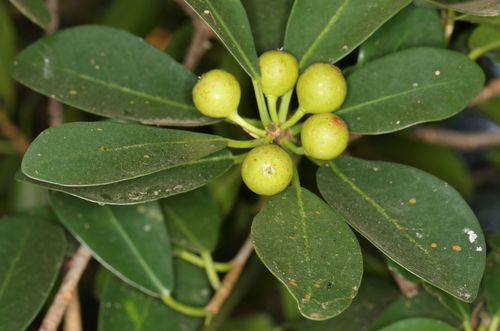
Natal fig
Ficus natalensis
The Natal fig is the ultimate backyard sanctuary, a 'living supermarket' that attracts everything from colorful fruit-eating birds to mischievous monkeys. Known for its glossy leaves and historical role in making barkcloth, this majestic tree is a cornerstone of African biodiversity.
Quick Identification
Size
Height ranges from 12-30 meters (40-100 feet) with a canopy spread often exceeding 20 meters (65 feet)
Colors
Deep glossy green leaves; bark is smooth and light grey to brownish; fruit (figs) transitions from green to yellow and finally dark red or purple when ripe
Key Features
- Glossy, leathery leaves with a rounded or blunt tip
- Small, stalkless (sessile) figs produced in pairs
- Smooth greyish bark traditionally used for barkcloth
- Massive spreading canopy often starting as an epiphyte
When You’ll See Them
Behavior
The Natal fig, or barkcloth fig, is a remarkable 'strangler' species. It often begins its life as an epiphyte, with seeds deposited by birds in the crevices of other trees. Over time, it sends aerial roots downward that eventually encase the host tree, though it can also grow as a standalone specimen. It is a keystone species in its ecosystem, providing a consistent food source for a vast array of wildlife.
Culturally, this tree is deeply significant, particularly in Uganda where the Baganda people have harvested its inner bark for centuries to create traditional barkcloth. This process involves stripping the bark and beating it with wooden mallets, after which the tree heals itself, allowing for sustainable harvesting. In a backyard or garden setting, it acts as a massive shade provider and a social hub for local fauna.
EverydayEarth exclusive
Camera Tips
To capture the best wildlife action on a Natal fig, do not aim your camera at the trunk. Instead, focus on the 'fruit-heavy' outer branches of the canopy. If you have a tall ladder or a way to mount your camera 3-5 meters up, aim it toward clusters of ripening figs. This is where you will see the most movement from Barbets, Turacos, and Green Pigeons. Use a fast trigger speed, as these birds move quickly between branches.
If you are looking for terrestrial visitors, place your camera near the base of the trunk where aerial roots meet the ground. Many small mammals like genets and mongooses use these root structures as 'ladders' or hiding spots. Angle the camera slightly upward to capture the scale of the tree while keeping the ground in view to catch any fallen fruit scavengers like duikers or bush pigs.
Lighting can be a challenge because the Natal fig’s leaves are exceptionally glossy. Midday sun can cause harsh glares and 'blow out' your photos. Position your camera facing south (in the southern hemisphere) to keep the sun behind the lens, or use the natural shade of the canopy to your advantage. Setting your camera to take short 10-second videos can be more rewarding than stills, as it captures the social interactions of the many species that congregate in the tree at once.
Keep a close eye on the color of the figs. When they transition from hard green to soft yellow or red, the 'fig rush' begins. This is the best time to ensure your batteries are at 100%. During a heavy fruiting cycle, you can expect hundreds of triggers in a single day as monkeys and birds compete for the best fruit. If your camera has a time-lapse mode, this can be a fantastic way to document the tree’s transition throughout the season.
Similar Species
Species that look similar or are commonly confused with Natal fig.
Common Wild Fig
Ficus thonningii has leaves that are usually more rounded at the base, and its figs are often slightly larger with subtle differences in the leaf stalk.
Cape Fig
Ficus sur produces much larger, clustered figs on the trunk and main branches rather than the small pairs found in the leaf axils of the Natal fig.
Frequently Asked Questions
Record Natal fig at your habitat
Connect a camera to start building your own species record — AI identifies every visitor automatically.