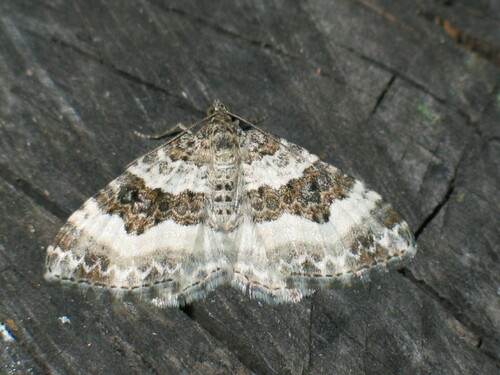
Wood Carpet
Epirrhoe rivata
A masterpiece of natural geometry, the Wood Carpet moth brings a touch of intricate elegance to the night garden. Often found resting on timber or stone, its delicate monochromatic patterns make it a favorite for backyard observers.
Quick Identification
Size
Wingspan of 28-34 mm (1.1-1.3 inches)
Colors
Greyish-brown forewings with a prominent, broad white central band that features a fine grey line running through it.
Key Features
- Broad white band across forewing containing a thin grey line
- Resting position with wings held flat and wide
- Double-lobed dark band bordering the white area
- Intricate grey and black marbled wing tips
When You’ll See Them
Behavior
The Wood Carpet is a nocturnal moth that relies on its intricate, tapestry-like wing patterns to remain undetected during the day. It is a master of crypsis, typically spending its daylight hours flattened against tree trunks, wooden fences, or tucked within dense foliage where its grey and white scales mimic the play of light and shadow.
As a member of the Geometridae family, its name comes from the way the larvae appear to 'measure the earth' as they move. The adults are primarily active from late spring through mid-summer, often appearing in two distinct broods. While they are solitary, they are highly sensitive to light and are frequent visitors to backyard light traps or even porch lights on warm, humid evenings.
EverydayEarth exclusive
Camera Tips
To successfully capture the Wood Carpet on your backyard camera, you need to think like a moth enthusiast. Since these insects are attracted to light, the most effective method is to set up a 'moth wall.' Hang a white cotton sheet over a fence or between two trees and illuminate it with a UV (blacklight) or a bright mercury vapor bulb. This creates a high-contrast landing pad that allows your AI camera to easily distinguish the moth from the background.
Position your camera on a tripod approximately 2 to 3 feet away from the sheet. Because the Wood Carpet is relatively small, use a macro setting if your camera supports it. If you are using a standard trail camera, check the minimum focal distance; if you get too close, the image will be blurry. If your camera has a 'time-lapse' mode, set it to trigger every 30 seconds once the sun goes down to catch visitors that might not be large enough to trigger a standard PIR motion sensor.
Exposure settings are critical. The Wood Carpet’s white bands are highly reflective and can easily 'blow out' and lose detail when hit with a camera flash. If possible, manually lower your exposure compensation or use a diffused light source rather than a direct, harsh flash. This will preserve the fine grey line within the white band, which is the key to identifying this species over its cousins.
Placement is best near 'wilder' parts of your garden. If you have patches of bedstraw or untrimmed hedgerows, set your light station nearby. Avoid windy nights, as these moths are light and will stay tucked away in the grass if the breeze is too strong. The best nights for photography are warm, still, and overcast, as the cloud cover keeps the ambient temperature high and encourages flight.
Similar Species
Species that look similar or are commonly confused with Wood Carpet.
Frequently Asked Questions
Record Wood Carpet at your habitat
Connect a camera to start building your own species record — AI identifies every visitor automatically.