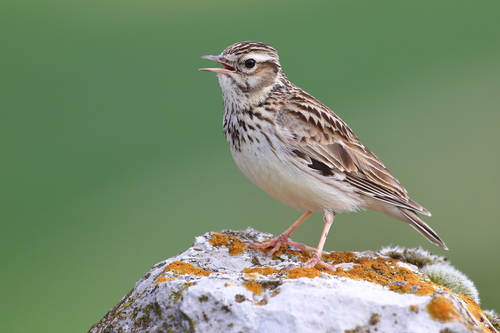
Woodlark
Lullula arborea
The Woodlark is the soulful songster of the forest edge, blending perfectly into the heathland with its masterfully camouflaged plumage. Discover the bird that inspired poets with its fluty, liquid song and distinctive white-streaked 'crown.'
Quick Identification
Size
Length: 13.5–15 cm (5.3–5.9 in); Wingspan: 27–30 cm (10.6–11.8 in); Weight: 25–35 g (0.9–1.2 oz)
Colors
Streaked warm brown and buff upperparts; creamy-white underparts with fine dark streaks on the breast; prominent white 'eyebrows' (supercilium) that meet at the back of the neck.
Key Features
- Distinctive white eyebrow stripes that meet in a 'V' shape at the nape
- Small, spiky crest that is often raised when the bird is alert
- Short tail with white tips on the outer feathers
- Black and white patch on the front edge of the wing (primary coverts)
When You’ll See Them
Behavior
The Woodlark is perhaps most famous for its beautiful, melancholic song—a series of descending fluty notes that often sounds like 'lu-lu-lu.' Unlike many other larks that sing exclusively while soaring, the Woodlark is just as comfortable singing from a high branch in a lone tree or while circling in a wide, undulating flight pattern. They are somewhat elusive birds, preferring to stay on the ground where their streaked plumage provides excellent camouflage against dry grass and soil.
These birds are generally solitary or found in pairs during the breeding season, though they may form small, loose flocks known as 'deserts' during the winter months. They are ground-nesters, carefully tucking their homes into tufts of grass or heather. While they are wary of human presence, they can become accustomed to quiet observers, particularly in areas where their habitat is managed for conservation.
EverydayEarth exclusive
Camera Tips
Capturing the Woodlark on an EverydayEarth camera requires a strategic approach because these birds rarely visit traditional hanging bird feeders. Instead, focus your camera on the ground. Look for 'scuff marks' in sandy soil or patches of short, mossy grass near forest edges. Placing your camera just 6-12 inches off the ground, angled slightly upward, will provide the most intimate view of their intricate feather patterns and that signature spiky crest.
Because Woodlarks are highly attracted to water for bathing and drinking—especially in the dry, sandy habitats they prefer—a ground-level birdbath or a shallow stone basin is your best bet for a 'hero shot.' Position the camera 3 to 5 feet away from the water source to ensure the AI can trigger and focus accurately on a bird of this size. If you are using a trail camera, ensure the trigger speed is set to its fastest setting, as Woodlarks move with quick, nervous hops.
Lighting is crucial for bringing out the subtle brown tones of their plumage. Try to position your camera facing North or South to avoid the harsh glare of a rising or setting sun, which can wash out the fine streaks on their breast. If you are monitoring a known territory, early spring is the best time to set up, as males will be active and vocal, often perching on the same low branch or fence post to survey their kingdom. Placing a camera near a prominent, solitary low perch can yield fantastic results.
Similar Species
Species that look similar or are commonly confused with Woodlark.
Frequently Asked Questions
Record Woodlark at your habitat
Connect a camera to start building your own species record — AI identifies every visitor automatically.