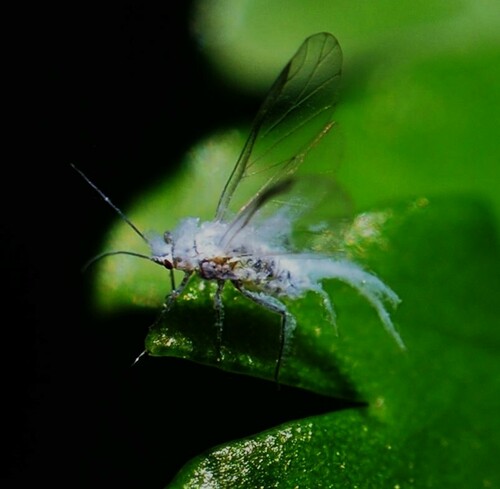
Woolly Beech Aphid
Phyllaphis fagi
Look closely at the underside of beech leaves and you might find a miniature winter wonderland. These tiny sap-suckers drape themselves in white waxy wool, creating fluffy colonies that dance in the breeze.
Quick Identification
Size
1–3 mm (0.04–0.12 inches) in length
Colors
Pale greenish-yellow body, but typically covered in long, white, cotton-like waxy filaments; eyes are dark red.
Key Features
- Long, white waxy 'wool' covering the body
- Found exclusively on the underside of beech tree leaves
- Secretes sticky honeydew that often attracts ants
- Grouped in dense colonies that look like white fuzz
When You’ll See Them
Behavior
The Woolly Beech Aphid is a master of disguise, wrapping itself in a protective coat of white, waxy strands that resemble tiny tufts of cotton. This 'wool' serves a dual purpose: it deters predators like ladybugs and lacewings by making the aphid difficult to handle, while also protecting the delicate insect from desiccation. They are almost exclusively found on the undersides of European beech leaves, where they huddle together in large, communal colonies during the spring and summer months.
These insects are specialized sap-suckers, using their needle-like mouthparts to pierce leaf veins and drink nutrient-rich fluids. As they process the sap, they excrete a sugary liquid called honeydew. This sticky substance often coats the leaves below the colony, encouraging the growth of black sooty mold and creating a miniature ecosystem that attracts a variety of other insects, including ants, wasps, and flies, who visit to feast on the sugary byproduct.
EverydayEarth exclusive
Camera Tips
Capturing the Woolly Beech Aphid requires a specialized approach because of their minuscule size. Standard trail cameras will likely fail to trigger or focus on such small subjects unless they have a dedicated macro lens or a very short minimum focus distance. For the best results, use a camera with a macro mode or an external macro attachment. Position your camera on a tripod extremely close—within 2 to 6 inches—of the underside of a beech leaf where you see visible white fuzz. Manual focus is highly recommended here, as the 'wool' can confuse autofocus systems.
Since these aphids are relatively stationary, they are excellent subjects for time-lapse photography. Set your camera to take a high-resolution photo every 2 to 5 minutes. Over several hours, this will reveal the slow expansion of the colony, the rhythmic movement of the aphids as they feed, and the fascinating visits from 'farming' ants. If your camera has a high-quality 4K video mode, try to capture the movement of the waxy 'wool' as it ripples when the aphids are disturbed by the wind or a passing predator.
Lighting is a major challenge under the dense canopy of a beech tree. The underside of a leaf is naturally shaded, making the white aphids appear dull or gray. Use a small external LED light or a diffused flash to bring out the crystalline texture of the white filaments. The best natural light occurs in the early afternoon when the sun is high enough to illuminate the leaves from the side, providing a translucent glow that makes the aphids pop against the green background.
Because these insects are so small, even a light breeze can move a leaf right out of your frame, resulting in a blurry mess. Use a 'third hand' hobby tool or a simple clothespeg to gently steady the specific branch or leaf you are filming. This stabilization is the secret to getting professional-grade wildlife footage of micro-fauna. Keep an eye out for ladybug larvae or hoverfly larvae—these are common predators that may enter the frame to hunt the aphids, adding dramatic action to your footage.
Similar Species
Species that look similar or are commonly confused with Woolly Beech Aphid.
Frequently Asked Questions
Record Woolly Beech Aphid at your habitat
Connect a camera to start building your own species record — AI identifies every visitor automatically.