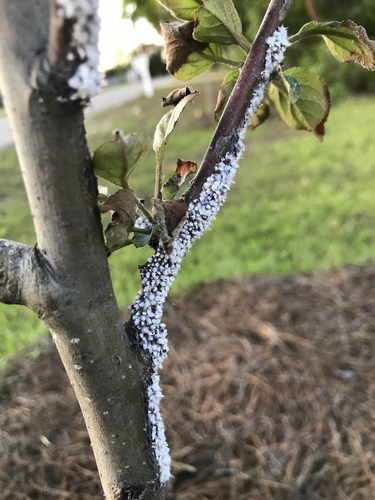
Woolly Apple Aphid
Eriosoma lanigerum
Often mistaken for a fungus or a bit of cotton, the Woolly Apple Aphid is a fascinating insect that builds its own waxy fortress. These sap-sucking specialists create miniature, snow-white worlds on the bark of backyard fruit trees.
Quick Identification
Size
Approximately 2 mm (0.08 inches) in length
Colors
Purplish-red or brown bodies, typically obscured by a thick, white, cotton-like waxy secretion
Key Features
- White, fluffy waxy coating resembling wool
- Clustered in dense colonies on bark and twigs
- Reddish fluid when crushed
- Presence of lumpy galls or 'knots' on tree limbs
When You’ll See Them
Behavior
The Woolly Apple Aphid is a master of disguise, cloaking its colony in a dense layer of white, waxy filaments that look more like a fungus or a dusting of snow than a group of insects. Unlike many aphids that congregate on leaves, these specialists focus on the woody parts of the tree—twigs, branches, and even roots. They use their needle-like mouthparts to pierce the bark and suck out the sugary sap, which often causes the tree to develop unsightly, bumpy galls or 'cankers.'
These aphids are highly social in their own way, living in tight-knit clusters to share the protection of their communal wax. Interestingly, they are often protected by ants, which 'farm' the aphids for their sweet honeydew secretions. While they don't move much once they find a feeding spot, they can be spread by the wind or by hitching rides on birds and larger insects.
EverydayEarth exclusive
Camera Tips
Capturing the Woolly Apple Aphid requires a specialized approach because of their tiny size and stationary nature. Since most standard trail cameras are designed for larger mammals, you will need a camera with macro-focus capabilities or a specialized 'macro' attachment for your lens. Position your camera just a few inches away from the tree's bark, specifically targeting pruning scars, cracks in the trunk, or the junctions where new growth meets old wood. These are the aphids' favorite hiding spots where they can safely feed on the sap.
Lighting is your biggest challenge with this species. The white waxy filaments are highly reflective and can easily wash out into a featureless white blob if overexposed by a flash or direct midday sun. Use a camera that allows you to adjust exposure settings (exposure compensation) to -1.0 or -2.0, or place the camera on the shaded side of the tree to capture the fine, hair-like details of the 'wool.' If your camera has a time-lapse mode, set it to take a photo every 15-30 minutes; while the aphids themselves move slowly, you will capture the fascinating arrival of predators like ladybugs, lacewings, and hoverfly larvae that hunt within the colonies.
Don't just look at the high branches—some populations of Woolly Apple Aphids live at the base of the tree near the soil line. Setting a camera low to the ground near the 'root flare' can reveal the aphids emerging from the roots to climb the trunk in the spring. For the best 'action' shots, aim your lens at a colony during the late afternoon. This is when you're most likely to see the aphids' 'honeydew' droplets glistening in the sun or the symbiotic ants that come to collect the sugar. Ensure your camera is securely mounted to the tree or a tripod, as any vibration at macro distances will result in a blurry image.
Similar Species
Species that look similar or are commonly confused with Woolly Apple Aphid.
Frequently Asked Questions
Record Woolly Apple Aphid at your habitat
Connect a camera to start building your own species record — AI identifies every visitor automatically.