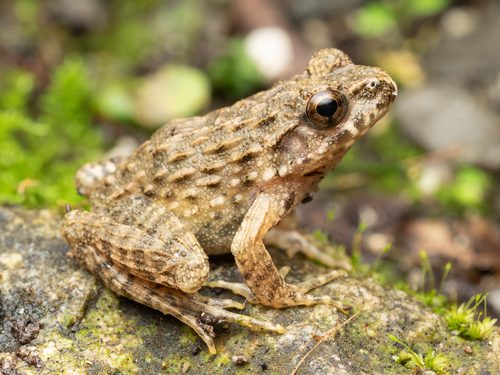
Wrinkled Frog
Glandirana rugosa
With its uniquely textured skin and resilient nature, the Wrinkled Frog is a master of camouflage in Japan's waterways and Hawaii's lush gardens. This hardy amphibian turns the muddy banks of backyard ponds into its own personal stage.
Quick Identification
Size
3 to 6 cm (1.2 to 2.4 inches) in length; females are generally larger than males.
Colors
Dull olive, dark brown, or grayish-green on the back; creamy yellow or white belly with distinct dark gray marbling.
Key Features
- Extremely bumpy, 'wrinkled' skin texture across the back
- Dull, camouflaged coloration with dark mottling
- Prominent dorsolateral folds (ridges) running down the sides
- Distinctive pungent odor produced from skin secretions when threatened
When You’ll See Them
Behavior
The Wrinkled Frog is a highly aquatic species that rarely ventures far from a water source. Unlike many other frogs that prefer only the calmest waters, these hardy amphibians are frequently found in slow-moving streams, drainage ditches, and rice paddies. They are known for their resilience and can often be seen perched on damp rocks or logs at the water's edge, ready to leap into the depths at the first sign of a predator.
Socially, they are most active during the breeding season when males congregate to call with a low, rasping sound that is less musical than other pond frogs. One of their most unique defensive traits is the production of a chemical secretion from their skin that emits a sharp, unpleasant odor, discouraging birds and small mammals from making them a meal. While they are generally shy around humans, they adapt well to suburban gardens that feature permanent ponds or water features.
EverydayEarth exclusive
Camera Tips
Capturing the Wrinkled Frog on camera requires a low-profile approach, as these frogs spend most of their time close to the ground or at the water's edge. Position your camera just a few inches above the soil line, tilted slightly upward if you are placing it on a pond bank. Because they are small and blend in perfectly with mud and wet stones, use a camera with a high-resolution sensor and a short focal distance to ensure their 'wrinkled' skin texture is visible rather than appearing as a blurry brown lump.
Since they are primarily nocturnal, your camera’s infrared (IR) flash is your best friend. Look for 'hotspots' where they might congregate, such as flat rocks protruding from a garden pond or the muddy margins of a backyard stream. Avoid placing the camera in areas with heavy splashing, as water droplets on the lens will ruin your night shots. Instead, aim for damp, mossy areas just a foot or two away from the main water body where they tend to sit and wait for passing insects.
If your camera has a 'time-lapse' or 'burst' mode, use it. These frogs can remain stationary for long periods, which may not trigger some motion sensors. A burst of three photos per trigger will help you catch the moment they snap up an insect or dive into the water. For the best results in a backyard setting, ensure your pond has some flat, 'landing pad' stones that are partially submerged; these are the most likely spots for a Wrinkled Frog to pose for a portrait. During the peak breeding months of June and July, activity will be at its highest, and you may even capture footage of males grappling for territory.
Similar Species
Species that look similar or are commonly confused with Wrinkled Frog.
Frequently Asked Questions
Record Wrinkled Frog at your habitat
Connect a camera to start building your own species record — AI identifies every visitor automatically.