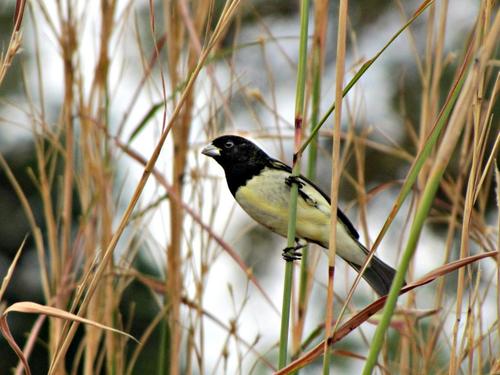
Yellow-bellied Seedeater
Sporophila nigricollis
With his dapper black hood and sunny yellow belly, the Yellow-bellied Seedeater is a cheerful presence in any grassy landscape. This tiny acrobat is a master of the meadows, turning common tall grasses into his personal jungle gym.
Quick Identification
Size
Length: 10–11 cm (4–4.3 in); Weight: 8–11 g (0.28–0.39 oz)
Colors
Males have a distinctive jet-black hood and throat, olive-green back, and pale yellow belly. Females are duller olive-brown with a buff-yellow underside.
Key Features
- Jet-black hood and throat in males
- Stubby, powerful conical beak
- Pale yellow to creamy underbelly
- Small, social build usually seen in groups
When You’ll See Them
Behavior
During the breeding months, the males become spirited songsters. They choose prominent perches, such as the tops of bushes or fence posts, to belt out a sweet, rapid-fire series of whistles and trills. They are relatively tolerant of human activity and are a common sight in suburban gardens that offer enough natural cover and seeding plants.
EverydayEarth exclusive
Camera Tips
Because they are small and move with quick, jerky motions, set your camera to its highest sensitivity and use a fast trigger speed. If your camera supports high-frame-rate video (60fps), use it—this will allow you to see the incredible dexterity of their beaks in slow motion as they husk seeds. Early morning light is the most flattering for their plumage; try to position the camera so the morning sun hits the bird's front, illuminating the contrast between the male's black hood and yellow belly.
Attracting them to a specific spot is easiest if you provide a shallow water source or a 'no-mow' zone. A birdbath with a solar dripper is particularly effective, as the sound of moving water will draw them in from nearby brush. If using a feeder to lure them into the frame, opt for a tray-style feeder with fine nyjer or millet seeds, but keep the feeder close to thick shrubs where they can quickly retreat if they feel threatened.
Similar Species
Species that look similar or are commonly confused with Yellow-bellied Seedeater.
Frequently Asked Questions
Record Yellow-bellied Seedeater at your habitat
Connect a camera to start building your own species record — AI identifies every visitor automatically.