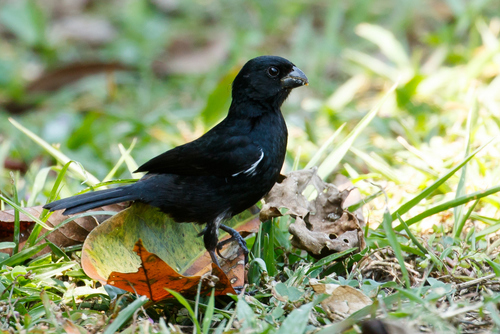
Variable Seedeater
Sporophila corvina
With its thick bill and surprisingly complex song, the Variable Seedeater is a charismatic staple of tropical gardens. Its plumage is a living map of evolution, shifting from jet-black to tuxedo-white across its vast range.
Quick Identification
Size
Length: 10.5-11.5 cm (4.1-4.5 in); Weight: 10-12 g (0.35-0.42 oz)
Colors
Males vary by region from entirely coal-black to black with white collars and bellies; females are consistently olive-brown above and paler buff below.
Key Features
- Thick, stubby black bill with a noticeably curved top edge
- Small white 'speculum' patch on the wing wings
- Males have highly variable black-and-white plumage depending on geography
- Energetic, buzzy song consisting of rapid warbles
When You’ll See Them
Behavior
The Variable Seedeater is a social and restless passerine, often seen in small groups or mixed flocks with other seed-eating species. They are remarkably comfortable around human habitation, frequently moving through suburban gardens, parks, and agricultural land. Their daily life revolves around 'milking' seeds from tall grass stems, a behavior where they cling to the stalk and pull the seeds through their beak.
During the breeding season, males become quite territorial and vocal, choosing prominent perches such as fence wires or the tops of shrubs to deliver their fast, buzzy songs. While they are primarily ground and low-shrub foragers, they are also surprisingly agile, occasionally performing short hover-flights to snatch insects or small berries. They are not particularly shy birds, making them excellent subjects for backyard observation.
EverydayEarth exclusive
Camera Tips
To get the best shots of a Variable Seedeater, you need to understand their vertical preferences. These birds spend most of their time between the ground and about six feet up. Set your camera at a height of 3 to 4 feet, aimed at a 'launching point'—typically a thin, horizontal branch or a wire fence—near a patch of long grass or a bird feeder. They rarely fly straight to a food source, preferring to land nearby first to scan the area.
If you are using a feeder to attract them, opt for a tray feeder or a hopper filled with white proso millet or fine cracked corn. Because they are small and quick, set your camera's shutter speed or 'motion sensitivity' to high. If your camera allows for burst mode, enable it; their habit of flicking their wings and tails makes for dynamic photos, but it can cause blur in single-shot setups.
Pay close attention to the lighting in your setup. The deep black feathers of the males can easily become a 'black hole' in photos if the sun is too bright, losing all texture. Position your camera so the sun is behind it, or place your feeding station in an area with bright, indirect light. In tropical regions, these birds are highly attracted to water; a shallow, textured bird bath placed in the sun can produce some of your best footage, as they are vigorous and frequent bathers.
Similar Species
Species that look similar or are commonly confused with Variable Seedeater.
Morelet's Seedeater
Smaller with a more prominent white collar and two white wing bars instead of one small patch.
Yellow-bellied Seedeater
Males have a distinct yellow belly and olive-green back, unlike the black and white of the Variable.
Wing-barred Seedeater
Closely related; the male has a more restricted black throat and more extensive white on the underparts.
Frequently Asked Questions
Record Variable Seedeater at your habitat
Connect a camera to start building your own species record — AI identifies every visitor automatically.