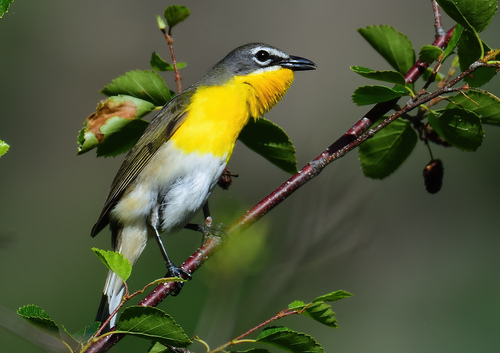
Yellow-breasted Chat
Icteria virens
The Yellow-breasted Chat is the ultimate prize for thicket-watchers, blending a brilliant golden plumage with a theatrical personality. Part songbird and part mimic, this elusive 'clown of the brush' turns your backyard into a stage for its bizarre whistles and hovering flight displays.
Quick Identification
Size
Length: 6.7–7.5 in (17–19.1 cm); Wingspan: 9–10.6 in (23–27 cm); Weight: 0.7–1.2 oz (20–33.8 g)
Colors
Bright olive-green upperparts with a brilliant lemon-yellow throat and breast; belly is white. Distinctive white 'spectacles' around the eyes; males have darker blackish feathers between the eye and bill.
Key Features
- Extraordinarily large and bulky for a songbird
- Bold white 'spectacles' against a gray-olive face
- Thick, slightly curved black bill
- Bright yellow chest contrasting with a clean white belly
When You’ll See Them
Behavior
The Yellow-breasted Chat is often described as the 'clown' of the bird world due to its eccentric behavior and bizarre vocalizations. Unlike many songbirds that stay in the canopy, the chat is a master of the thicket, preferring to stay hidden in dense, thorny brush. Despite their secretive nature, they are remarkably loud, producing a chaotic medley of whistles, chuckles, rattles, and cat-like meows that can often be heard long before the bird is seen.
During the breeding season, males perform a unique flight display that is a highlight for any wildlife observer. They launch themselves into the air, pumping their wings slowly and letting their legs dangle awkwardly while singing a jumbled series of notes. While they are technically members of their own unique family (Icteriidae), they possess a curious, almost mocking intelligence in their interactions with other birds, often mimicking the sounds of their neighbors.
EverydayEarth exclusive
Camera Tips
Capturing a Yellow-breasted Chat on camera requires strategy because they rarely visit traditional bird feeders. Instead of an open-air bird table, place your AI camera near a solar-powered bubbling birdbath or a shallow ground-level water feature. Chats are much more likely to drop down from their dense cover for a quick bath than they are to hop onto a platform. Ensure the camera is positioned just 12 to 24 inches off the ground, as these birds spend the majority of their time in the lower strata of the scrub.
If you have a corner of your yard that is a bit 'wild'—think overgrown blackberry bushes or thick privet—that is your prime camera location. Position the lens facing the edge of the thicket where the light is consistent. Avoid pointing it directly into the dark brush, or the sensor may struggle to trigger. Setting your camera to 'Video' mode rather than just stills is highly recommended; their jerky movements and vocalizations are far more interesting to witness in motion than in a single frame.
For the best results during the peak breeding months of May and June, use a camera with a high-sensitivity PIR (Passive Infrared) sensor. Because chats move in quick, short bursts through the leaves, a slow trigger speed will result in nothing but a blurry yellow tail. High frame rates (60fps if available) will help you catch the detail of their 'spectacles' and their thick bills as they forage for insects along the stems of shrubs.
Lastly, consider the season. While they are elusive in the spring, they become slightly more visible in late July and August when wild berries ripen. If you have elderberry, serviceberry, or wild grapevines, aim your camera at the fruiting clusters. A little bit of patience goes a long way with this species; they are naturally curious but extremely cautious about entering open spaces.
Similar Species
Species that look similar or are commonly confused with Yellow-breasted Chat.
Frequently Asked Questions
Record Yellow-breasted Chat at your habitat
Connect a camera to start building your own species record — AI identifies every visitor automatically.