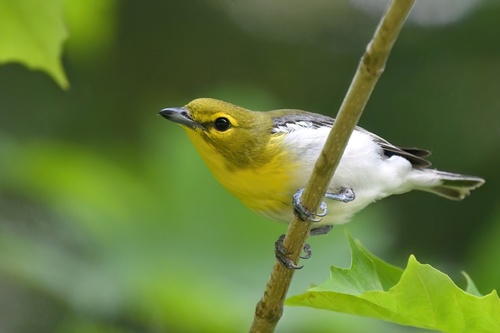
Yellow-throated Vireo
Vireo flavifrons
With its brilliant yellow 'spectacles' and rich, buzzy song, the Yellow-throated Vireo is a crown jewel of the mature forest. Though they prefer the high canopy, these deliberate hunters are a spectacular sight when they descend for a mid-day bath.
Quick Identification
Size
Length: 5.1-5.9 in (13-15 cm); Wingspan: 9.1-9.8 in (23-25 cm); Weight: 0.5-0.7 oz (15-21 g)
Colors
Bright yellow throat and upper breast; yellow 'spectacles' (rings around eyes and bridge across bill); olive-green back; gray rump and tail; white belly; two bold white wing bars.
Key Features
- Vivid yellow throat and breast contrasting with a pure white belly
- Distinctive yellow spectacles around the eyes
- Two prominent white bars on dark gray wings
- Thick, slightly hooked bill and a stocky build compared to warblers
When You’ll See Them
Behavior
The Yellow-throated Vireo is a patient and methodical forager of the forest canopy. Unlike the energetic, flitting movements of warblers, this species moves slowly through the foliage, often staying still for several seconds to scan for large insects or caterpillars. They are more often heard than seen, as they possess a husky, buzzy song that they repeat tirelessly throughout the day, even during the heat of mid-afternoon.
These birds are generally solitary or found in pairs during the breeding season, though they may join mixed-species flocks during their spring and fall migrations. While they are not overly shy, their preference for the high branches of mature deciduous trees makes them a challenge for the casual observer. They are socially monogamous and both parents contribute to building their characteristic cup-shaped nests, which are often decorated with lichens and spiderwebs.
EverydayEarth exclusive
Camera Tips
Because Yellow-throated Vireos spend the vast majority of their lives in the high canopy, your best chance of capturing them on a backyard camera is by providing a reliable water source. A birdbath or a fountain with a solar-powered dripper is an excellent lure. The sound of moving water is a powerful attractant that can pull these canopy dwellers down to ground level. Position your camera about 3 to 4 feet from the water source at a slightly downward angle to capture the bird's vivid yellow throat as it dips its head to drink or bathe.
Lighting is critical for this species because their yellow plumage can easily become overexposed in direct sunlight. Try to place your camera and water feature in a spot that receives dappled sunlight or soft morning light. If you are using a trail camera, set it to 'Photo + Video' mode with a high trigger speed. These birds are deliberate but their visits to the ground are often brief, and you don’t want to miss the landing or the initial splash. A 10-second video clip is often enough to record their unique bathing behavior.
During the nesting season (late May through early July), you can attempt to locate their nests, which are typically suspended from the fork of a horizontal branch 20 to 50 feet up. If you have a camera that can be safely mounted high in a tree, focus on the outer branches of mature oaks or maples. However, for most backyard setups, stick to the 'water-trap' method. While they won't visit standard seed feeders, placing a small dish of live mealworms near your camera may occasionally pique the interest of a parent bird looking for a high-protein snack for its fledglings.
In terms of seasonal timing, focus your efforts in late August and early September. This is when the birds are preparing for migration and are more likely to descend from the canopy to forage on lower-hanging berries or to use communal water sources. During this window, ensure your camera is active throughout the day, as migration energy demands mean they may visit the water at any hour, not just during the peak morning singing hours.
Similar Species
Species that look similar or are commonly confused with Yellow-throated Vireo.
Pine Warbler
Lacks the yellow spectacles and has a thinner, straighter bill and faint streaking on its sides.
Blue-headed Vireo
Has similar spectacles but features a starkly gray head and a white throat instead of yellow.
Yellow-breasted Chat
Much larger with a longer tail and lacks the white wing bars found on the Yellow-throated Vireo.
Frequently Asked Questions
Record Yellow-throated Vireo at your habitat
Connect a camera to start building your own species record — AI identifies every visitor automatically.