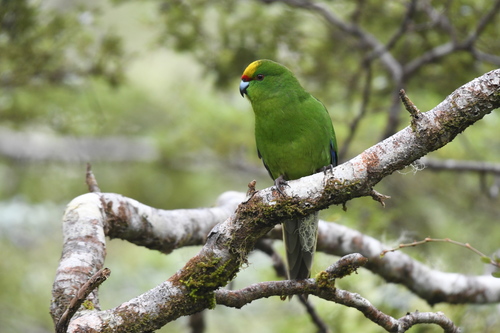
Yellow-crowned Parakeet
Cyanoramphus auriceps
A flash of emerald and gold in the New Zealand bush, the Yellow-crowned Parakeet is a resilient and acrobatic treasure of the forest canopy.
Quick Identification
Size
Length 23-25 cm (9-10 in); weight 80-100 g (2.8-3.5 oz)
Colors
Bright emerald green body, golden-yellow crown, small crimson-red band above the nostrils, and violet-blue flight feathers. Males and females look similar, though males are slightly larger.
Key Features
- Distinctive golden-yellow patch on the forehead
- Small crimson-red band between the eye and beak
- Emerald green plumage with violet-blue outer wing feathers
- Long, slender tail and rapid, undulating flight
When You’ll See Them
Geographic range
Where Does the Yellow-crowned Parakeet Live?
The Yellow-crowned Parakeet is endemic to New Zealand, occurring naturally across the North, South, and Stewart Islands, as well as the subantarctic Auckland Islands. While they are most concentrated in large, contiguous tracts of native forest, they are also found on several predator-free offshore islands where populations are thriving. Unlike some other native species, they have managed to persist on the mainland, though they are most common in areas with active conservation management.
Basemap © OpenStreetMap contributors
Behavior
The Yellow-crowned Parakeet, known by its Māori name kākāriki, is an energetic and highly vocal bird. Unlike many other parrot species that congregate in large noisy flocks, these parakeets are more often seen in pairs or small family groups. They are masters of the forest canopy, using their beaks and claws to climb expertly through dense foliage in search of food. Their presence is usually announced by a distinctive, high-pitched 'ki-ki-ki-ki' chatter that echoes through the trees.
These birds are particularly active during the early morning and late afternoon. While they are generally more elusive and forest-dwelling than the Red-crowned Parakeet, they are known for their inquisitive nature. In areas where predator control is high, they have become more comfortable around human dwellings, often visiting backyard gardens that offer native food sources or water baths. They are cavity nesters, often choosing holes in old-growth trees to raise their young.
EverydayEarth exclusive
Camera Tips
To capture the Yellow-crowned Parakeet on your backyard camera, focus on height and water. These birds prefer the mid-to-upper canopy, so mounting your camera 6 to 10 feet high on a tree trunk, angled toward a known perching branch or a high-mounted bird bath, will yield the best results. They are particularly attracted to shallow, clean water for drinking and bathing, especially during the drier summer months.
Because kākāriki have brilliant green plumage that blends into the leaves, use a camera with a high-resolution sensor and fast trigger speed. Set your device to record 10-20 second video clips rather than still photos; their rapid movements and constant head-bobbing are much easier to identify in motion. If you are using a trail camera in a forest setting, look for 'flyways'—clear paths through the understory that the birds use to navigate between feeding areas.
Baiting is rarely effective with this species, but planting native New Zealand flora like flax (harakeke) or kōwhai near your camera site acts as a permanent, natural lure. During the spring breeding season, they are more vocal and active, making this the ideal time to check your footage for social interactions or pairs scouting for nesting hollows.
Similar Species
Species that look similar or are commonly confused with Yellow-crowned Parakeet.
Frequently Asked Questions
Record Yellow-crowned Parakeet at your habitat
Connect a camera to start building your own species record — AI identifies every visitor automatically.