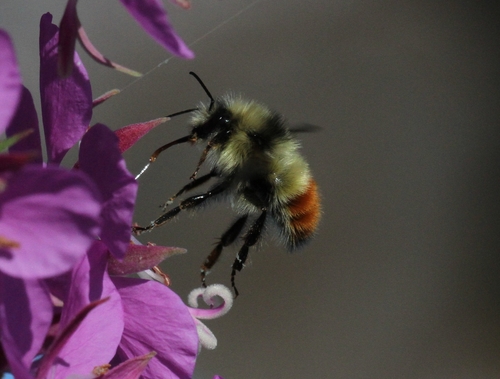
Yellow-fronted Bumble Bee
Bombus flavifrons
A golden-crowned engine of the garden, the Yellow-fronted Bumble Bee is a master of buzz pollination and a vital link in our western ecosystems.
Quick Identification
Size
Queens: 14–16 mm (0.55–0.63 in); Workers: 10–12 mm (0.39–0.47 in); Males: 11–13 mm (0.43–0.51 in)
Colors
Bright yellow hair on the face and front of the thorax; abdomen features variable bands of yellow, black, and often reddish-orange on the middle segments.
Key Features
- Distinctive dense yellow hair on the face and top of the head
- Thorax is primarily yellow with a black band or patch between the wing bases
- Abdominal segments 2 and 3 frequently show reddish-orange or cloudy-yellow hairs
- Medium-length tongue adapted for a wide variety of flower shapes
When You’ll See Them
Behavior
The Yellow-fronted Bumble Bee is a social and highly industrious pollinator common across Western North America. Like many of its cousins, this species follows an annual life cycle: a lone queen emerges from hibernation in the spring, selects a nesting site—often in an abandoned rodent burrow or a dense clump of grass—and begins the hard work of raising her first generation of workers.
These bees are known for their 'buzz pollination' technique, where they grab onto a flower and vibrate their flight muscles to shake pollen loose from the anthers. This behavior makes them exceptionally efficient at pollinating garden favorites like tomatoes and peppers. While they are protective of their nests, they are remarkably docile when foraging and will generally ignore humans as they move methodically from flower to flower.
EverydayEarth exclusive
Camera Tips
To capture the best footage of a Yellow-fronted Bumble Bee, you need to think like a gardener. These bees are 'patch foragers,' meaning they find a rich source of nectar and return to it repeatedly. Place your AI-powered camera on a tripod or stake just 12 to 18 inches away from high-nectar 'target plants' like Lavender, Salvia, or Lupine. For the best identification shots, try to position the camera so it captures the bee from the side or slightly from above; this allows the AI to clearly see the yellow hair on the face and the specific banding patterns on the abdomen.
Lighting is the biggest challenge when filming small, fast-moving insects. Set up your camera in an area that receives bright, indirect morning light. Harsh midday sun can create 'hot spots' on the bee’s fuzzy coat, causing the camera to lose detail in the yellow highlights, while deep shade can make the bee appear as a dark blur. If your camera has a 'high sensitivity' or 'small subject' mode, enable it to ensure the motion of a 12mm bee triggers the recording. Because these bees are small, traditional heat-based PIR sensors might miss them; cameras with pixel-based motion detection are much more effective.
If you want to record the fascinating behavior of a queen establishing her colony, look for her in the early spring (March to May). She will often be seen flying low to the ground in a zig-zag pattern, searching for a hole. Placing a camera near a potential nesting site—like a rock wall or a patch of undisturbed tall grass—can provide a rare glimpse into the start of a colony. During the peak of summer, keep a shallow water dish with stones for them to land on nearby; capturing a bee drinking is a unique behavior that looks fantastic on camera.
Similar Species
Species that look similar or are commonly confused with Yellow-fronted Bumble Bee.
Frequently Asked Questions
Record Yellow-fronted Bumble Bee at your habitat
Connect a camera to start building your own species record — AI identifies every visitor automatically.