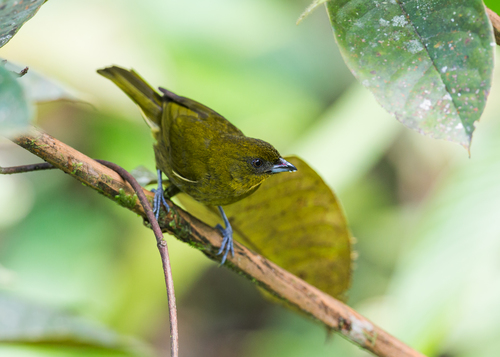
Yellow-green Tanager
Bangsia flavovirens
An elusive jewel of the Chocó-Andean slopes, the Yellow-green Tanager blends perfectly into the emerald canopy of the cloud forest. Rare and restricted in range, this striking bird is a prize find for any wildlife observer.
Quick Identification
Size
13.5–14.5 cm (5.3–5.7 in) in length; weighs approximately 20–30 g (0.7–1.1 oz)
Colors
Overall yellowish-olive or grass-green plumage; throat and center of the belly are a brighter, clearer yellow; dark reddish-brown to crimson iris; dark greyish bill
Key Features
- Uniformly olive-green upperparts without streaking
- Vibrant yellow throat and chest
- Stocky, short-tailed silhouette
- Dark reddish eyes in adults
When You’ll See Them
Geographic range
Where Does the Yellow-green Tanager Live?
Native to the South American continent, the Yellow-green Tanager is a regional endemic restricted to the humid Chocó bio-region. Its core range is located along the western slopes of the Andes in Colombia and northwestern Ecuador. Because of its very specific habitat requirements, it is not found outside of these two countries, and there are no known introduced populations globally.
Basemap © OpenStreetMap contributors
Behavior
The Yellow-green Tanager is an active, arboreal bird that spends most of its time in the mid-to-upper levels of the forest canopy. While it was once thought to be a bush tanager, its behavior aligns more closely with the true tanagers, often seen hopping quickly through mossy branches in search of food. They are social birds but are typically found in pairs or as part of larger mixed-species foraging flocks, traveling alongside honeycreepers and other tanagers.
These birds are not particularly shy, but their plumage provides excellent camouflage against the sun-dappled leaves of the Chocó rainforest, making them difficult to spot without a camera. They are vocal, frequently emitting high-pitched 'tsit' calls to maintain contact with their partners. Interactions with humans are rare due to their specialized habitat, but they are highly responsive to the presence of fruiting trees in forest clearings.
EverydayEarth exclusive
Camera Tips
To capture the Yellow-green Tanager, your camera placement is everything. Since this species prefers the mid-canopy and forest edges, mounting your camera at eye level (about 5-6 feet) on a slope or near a balcony overlooking a ravine is often more effective than ground-level setups. They are particularly drawn to fruiting trees, so identify native berry-producing shrubs like Miconia; placing your camera with a clear view of these ripening fruits will significantly increase your hit rate.
Because the Chocó region is notoriously wet and humid, ensure your camera housing is rated for high moisture and use desiccant packs inside the battery compartment to prevent lens fogging. Lighting can be a challenge under the dense canopy, so set your camera to a higher ISO sensitivity if possible, or position it where it can catch the morning light filtering through the trees. Avoid using heavy flashes that might wash out their subtle olive-green tones; instead, rely on fast trigger speeds to catch their quick, hopping movements.
If you are in a rural or forest-edge property within their range, a birdbath or a shallow dripping water feature can be an irresistible lure. These tanagers are meticulous about their feathers and will descend from the canopy for a quick bath during the hottest part of the mid-morning. Set your camera to 'Burst Mode' or high-definition video to capture the rapid wing beats and water splashes, as their visits to the ground are usually very brief.
Similar Species
Species that look similar or are commonly confused with Yellow-green Tanager.
Frequently Asked Questions
Record Yellow-green Tanager at your habitat
Connect a camera to start building your own species record — AI identifies every visitor automatically.