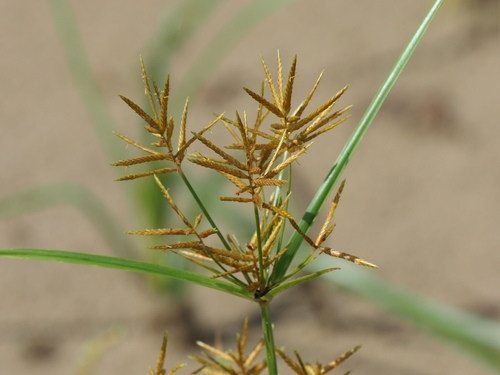
yellow nutsedge
Cyperus esculentus
Often mistaken for a common weed, yellow nutsedge is an ancient survivalist plant that produces delicious, nutrient-dense tubers known as 'tiger nuts.' Its unique triangular stems and golden flower clusters make it a fascinating study in backyard resilience.
Quick Identification
Size
12-36 inches (30-91 cm) in height; tubers are 0.4-0.8 inches (1-2 cm) long
Colors
Bright yellow-green foliage with golden-brown or straw-colored seed heads
Key Features
- Distinctly triangular stem ('sedges have edges')
- Long, grass-like leaves with a prominent mid-vein
- Yellowish-brown umbrella-like flower clusters
- Hard, nut-like underground tubers called tiger nuts
When You’ll See Them
Behavior
Yellow nutsedge is a resilient perennial that often mimics the appearance of common lawn grasses but follows a very different growth strategy. Unlike most grasses, it spreads through a sophisticated system of underground rhizomes that terminate in small, starchy tubers known as 'tiger nuts.' These tubers are survival powerhouses, capable of remaining dormant in the soil for several years before sprouting when conditions—specifically moisture and heat—become ideal.
In a backyard setting, this species is known for its aggressive colonization of damp, poorly drained soil. It grows significantly faster than most turfgrasses during the heat of mid-summer, often sticking out as a taller, lime-green patch in an otherwise uniform lawn. While many consider it a nuisance weed, it has been a significant food source for humans for millennia, notably in ancient Egypt and modern-day Spain, where it is the primary ingredient in the creamy beverage horchata de chufa.
EverydayEarth exclusive
Camera Tips
To successfully capture yellow nutsedge on your backyard camera, you should treat it as a subject for time-lapse photography rather than motion-based triggers. Because the plant moves slowly as it grows, configure your AI-powered camera to take a scheduled photo every 4 to 6 hours. This will allow you to see the dramatic 'bolt' that occurs in mid-summer when the plant sends up its tall, triangular flower stalks. Position your camera on a low-profile stake about 12 inches from the ground, ensuring the lens is angled slightly upward to capture the architectural beauty of the seed heads against the sky.
If you are interested in the wildlife that yellow nutsedge attracts, focus your camera on the base of the plant during the autumn months. Many foragers, including squirrels, chipmunks, and even wild turkeys, are highly attracted to the nutritious tubers. To catch this 'digging' behavior, set your camera's motion sensitivity to high and use a wide-angle lens setting. The best shots often happen in the early morning when the dew clings to the yellow-green blades, providing a high-contrast look that makes the plant pop against darker soil.
Lighting is the biggest challenge when photographing this species, as its bright, waxy leaves can reflect sunlight and cause overexposure. To get the best color accuracy, prioritize the early morning or late afternoon 'golden hours.' If your camera allows for manual exposure adjustments, dial it down slightly to preserve the rich, golden-brown details of the flower spikes (umbels). Avoid placing the camera where it will face the direct midday sun, as the 'tiger nut' foliage can lose its characteristic lime-green hue in harsh light.
Similar Species
Species that look similar or are commonly confused with yellow nutsedge.
Frequently Asked Questions
Record yellow nutsedge at your habitat
Connect a camera to start building your own species record — AI identifies every visitor automatically.