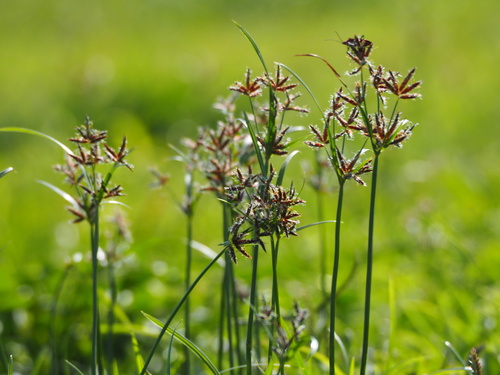
Purple nutsedge
Cyperus rotundus
Meet the 'world's worst weed'—a master of survival that builds a secret underground empire. Purple Nutsedge is a fascinating, triangular-stemmed survivor that has outlasted civilizations.
Quick Identification
Size
6–20 inches (15–50 cm) tall; leaves are 2–8 inches (5–20 cm) long
Colors
Glossy dark green leaves; reddish-purple to chocolate brown flower spikelets
Key Features
- Triangular stem that is solid and core-less
- Leaves arranged in sets of three from the base
- Reddish-purple terminal flower clusters
- Extensive underground network of tubers or 'nuts'
When You’ll See Them
Behavior
Purple Nutsedge is often called the 'world's worst weed' due to its incredible resilience and ability to thrive in over 90 countries. Unlike most garden plants that spread primarily by seed, this sedge builds a complex, interconnected underground empire. It produces chains of tubers (the 'nuts') linked by rhizomes, allowing a single plant to quickly colonize a backyard or garden bed. Even if you pull the visible green blades, the tubers remain buried deep, ready to send up new shoots within days.
This species is highly competitive, secreting chemicals from its roots that can inhibit the growth of neighboring plants—a process known as allelopathy. While homeowners may find it frustrating, it has a rich history in traditional medicine and was even a staple food for ancient populations before the advent of modern agriculture. In a backyard ecosystem, it provides cover for small insects and its tubers are occasionally sought out by foraging mammals.
EverydayEarth exclusive
Camera Tips
Capturing the life of a plant like Purple Nutsedge requires a different strategy than tracking moving animals. To truly see the 'behavior' of this sedge, configure your trail camera to Time-Lapse mode rather than Motion-Triggered mode. Set the interval to one photo every 30 to 60 minutes during daylight hours. Over a week, this will allow you to see the rapid upward growth of the blades and the dramatic unfolding of the purple flower spikes. If your camera supports high-definition video, a short time-lapse sequence can reveal how the leaves move throughout the day to track the sun.
For the best identification shots to help your AI software distinguish it from grass, place the camera at a low 'worm's-eye' angle, about 4 to 6 inches off the ground. Aim for a side-profile shot of the stem. Because the most distinctive feature of a sedge is its triangular stem (remember the saying: 'Sedges have edges'), a clear shot of the base where the leaves meet the stem is vital. Use a macro lens attachment if available to capture the fine details of the reddish-purple glumes in the flower head.
Position your camera in a sun-drenched part of your yard where the soil stays slightly damp, as this is where Purple Nutsedge grows most vigorously. Avoid placing the camera in deep shade, as the plant will look leggy and less characteristic. If you are trying to capture the wildlife that interacts with the sedge, look for early morning windows (6–9 AM) when dew clings to the blades, attracting small pollinators or thirsty insects like ladybugs and beetles.
Be mindful of the background; a busy or cluttered background can make it hard for AI models to isolate the fine blades of the sedge. Use a piece of neutral-colored cardboard or a simple garden stone behind the plant during your setup to create high contrast. This ensures the camera’s focus stays locked on the unique architecture of the nutsedge rather than shifting to swaying trees in the distance.
Similar Species
Species that look similar or are commonly confused with Purple nutsedge.
Frequently Asked Questions
Record Purple nutsedge at your habitat
Connect a camera to start building your own species record — AI identifies every visitor automatically.