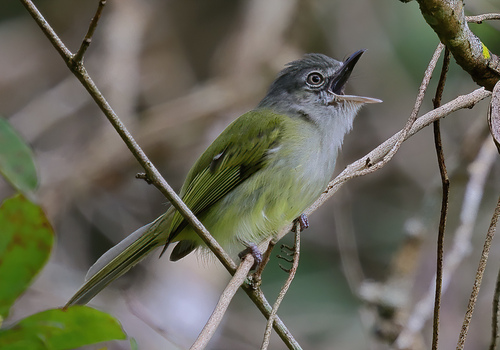
Yellow-olive Flatbill
Tolmomyias sulphurescens
A master of the mid-canopy, the Yellow-olive Flatbill is a charming Neotropical specialist known for its distinctive 'spectacles' and expert fly-catching abilities. Distributed from Mexico to Argentina, it is a vibrant addition to any tropical backyard birding list.
Quick Identification
Size
13-14.5 cm (5.1-5.7 in) in length; weighs approximately 13-17.5 g (0.46-0.62 oz)
Colors
Olive-green upperparts, bright yellow to sulfur-yellow belly, grayish throat, and dusky wings with two yellowish-white wing bars.
Key Features
- Broad and distinctly flattened bill with a pale lower mandible
- Pale yellow or whitish 'spectacles' and eye-ring
- Two prominent yellowish wing bars
- Relatively large head for its body size
When You’ll See Them
Geographic range
Where Does the Yellow-olive Flatbill Live?
This resilient flycatcher is native to the Neotropics, with a massive range that begins in southern Mexico and extends through every country in Central America. In South America, it is found across the entire continent east of the Andes, reaching as far south as northern Argentina and Uruguay, though it is notably absent from the high mountains and the country of Chile. It is a common resident in the Amazon basin and can also be found on the island of Trinidad.
Basemap © OpenStreetMap contributors
Behavior
The Yellow-olive Flatbill is an active and somewhat inconspicuous resident of the mid-canopy. It is a classic 'sit-and-wait' predator, often seen perching upright on slender branches while scanning for insect prey. Once an insect is spotted, the bird performs a quick, acrobatic sally, snatching the prey from the air or gleaning it from the underside of a leaf with a loud snap of its bill.
While they are primarily solitary or found in pairs, these birds are frequent participants in mixed-species foraging flocks, moving through the forest alongside tanagers and woodcreepers. They are more often heard than seen; their vocalizations consist of sharp, buzzy, or wheezy notes that carry well through dense foliage. Unlike some flycatchers that migrate long distances, the Flatbill is a year-round resident across most of its vast range.
EverydayEarth exclusive
Camera Tips
To successfully capture a Yellow-olive Flatbill on your backyard camera, placement is everything. Since these birds rarely descend to the ground, mount your camera at a height of 8 to 15 feet, aiming it toward horizontal 'perching branches' near the edge of a wooded area. They are attracted to open pockets within the foliage where they have room to maneuver during their hunting sallies.
Because they are insect-eaters, standard birdseed won't work as a lure. Instead, focus your camera on a high-mounted water source. A birdbath with a solar-powered dripper or a mister is highly effective, as the sound and movement of water will draw them down from the canopy for a drink or a bath. Position the camera to face north or south to avoid lens flare during the early morning hours when they are most active.
Adjust your camera settings for a fast trigger speed and high-resolution video. These birds move quickly and their 'sally' happens in a fraction of a second. If your camera has a 'Pre-Roll' feature, enable it so you don't miss the moment they launch from their perch. Since they live in dappled light environments, use a camera with good dynamic range to ensure the bright yellow of their belly isn't 'blown out' by the sun while their olive back remains visible in the shade.
Similar Species
Species that look similar or are commonly confused with Yellow-olive Flatbill.
Frequently Asked Questions
Record Yellow-olive Flatbill at your habitat
Connect a camera to start building your own species record — AI identifies every visitor automatically.