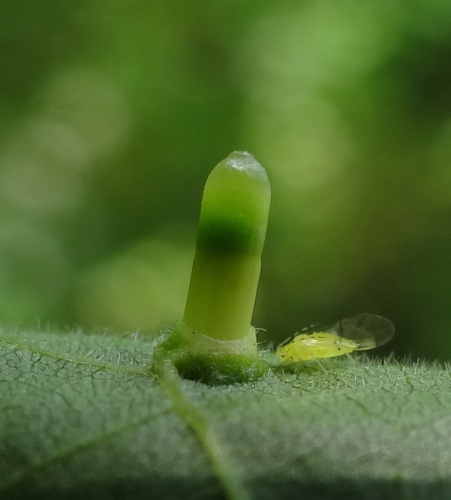
Yellow Pecan Aphid
Monelliopsis pecanis
The Yellow Pecan Aphid is a tiny golden gem of the insect world, common in any backyard with a pecan tree. Watch closely to see these translucent insects interact with ants in a complex dance of survival and symbiosis.
Quick Identification
Size
Approximately 1.5 to 2.0 mm (0.06 to 0.08 inches) in length
Colors
Bright yellow to pale greenish-yellow; translucent body with clear wings in the alate (winged) form
Key Features
- Translucent yellow pear-shaped body
- Wings held flat over the back when at rest
- Found almost exclusively on the underside of pecan leaves
- Lacks the dark spots found on the Black Pecan Aphid
When You’ll See Them
Behavior
The Yellow Pecan Aphid is a specialized sap-sucking insect that spends its entire lifecycle on pecan trees. Unlike many other aphid species that form dense, stationary colonies, these aphids are somewhat mobile and tend to disperse across the underside of leaves. They feed by piercing the leaf tissue to reach the phloem, extracting nutrient-rich sap. This feeding process results in the excretion of 'honeydew,' a sticky, sugar-rich substance that coats the leaves below.
These insects are social in a loose sense, often found in small groups, and they have a fascinating relationship with other backyard residents. You will frequently see ants 'farming' them, protecting the aphids from predators like ladybugs and lacewings in exchange for a taste of the honeydew. When threatened, Yellow Pecan Aphids can perform a characteristic 'kicking' motion with their hind legs to ward off small parasitoid wasps.
EverydayEarth exclusive
Camera Tips
Capturing the Yellow Pecan Aphid requires a specialized approach because of their minuscule size. To get high-quality images or video using an AI-powered backyard camera, you must use a macro lens attachment. Most standard trail cameras will not focus close enough to resolve an insect that is only 2mm long. Mount your camera on a flexible tripod and position it so the lens is within 2 to 4 inches of the underside of a pecan leaf. Choose leaves on lower branches that are easily accessible and relatively sheltered from the wind to prevent motion blur.
Lighting is the most critical factor for these translucent insects. Because they live on the undersides of leaves, they are often in deep shade. Use a small LED fill light or a white reflector to bounce soft, natural light upward toward the bottom of the leaf. This will illuminate their yellow bodies and make them pop against the green background. If your camera allows for manual settings, use a high shutter speed to freeze the movement of the leaf and the aphid's legs.
Timing your shots can lead to much more interesting footage. Don't just look for the aphids; look for the ants. If you see ants patrolling a specific branch, follow them—they will lead you directly to the aphid colonies. Setting your camera to record short video clips (10-15 seconds) is often better than still photos, as you can capture the 'honeydew' exchange between the aphid and the ant, or the arrival of a predatory ladybug larvae. During the peak of summer, these interactions are constant and provide a fascinating window into the micro-world of your backyard.
Similar Species
Species that look similar or are commonly confused with Yellow Pecan Aphid.
Frequently Asked Questions
Record Yellow Pecan Aphid at your habitat
Connect a camera to start building your own species record — AI identifies every visitor automatically.