Yellow Perch
Perca flavescens
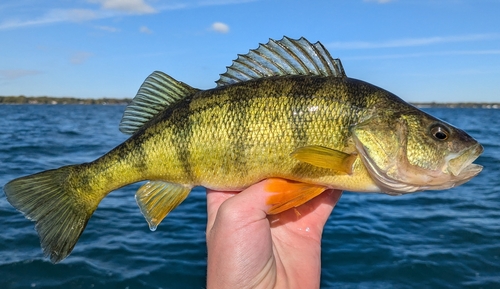
Recognizable by their bold 'tiger stripes' and golden scales, the Yellow Perch is a social and curious staple of North American freshwater. These schooling fish are a delight to observe as they weave through underwater forests in search of their next meal.
Quick Identification
Size
Typically 6–12 inches (15–30 cm) in length and 0.25–1 lb (0.1–0.5 kg) in weight, though 'jumbos' can reach 16 inches and over 2 lbs.
Colors
Bright golden-yellow to brassy-green body with 6–8 dark vertical bars (stripes). The belly is white or pale yellow, and the lower fins (anal and pelvic) often turn bright orange or red during spawning.
Key Features
- 6–8 dark vertical 'tiger stripes' on the sides
- Two distinct dorsal fins, the first having sharp spines
- Golden-yellow body with a white underbelly
- Orange-tinted lower fins and a slightly forked tail
When You’ll See Them
Behavior
Yellow Perch are highly social, gregarious fish that spend most of their lives in large schools. These schools are usually organized by age and size, with younger fish forming massive, dense groups for protection against predators, while older 'jumbo' perch travel in smaller, more elite pods. They are not particularly territorial and are known for their inquisitive nature, often being the first species to investigate new objects or disturbances on the lake floor.
Unlike many freshwater predators that hunt under the cover of darkness, Yellow Perch are strictly diurnal. They begin their day at sunrise, spend the daylight hours foraging along the bottom or weaving through weed beds, and then find a spot to rest on the bottom as night falls. They are relatively slow swimmers, relying on the safety of the group and their vertical stripes, which provide excellent camouflage among tall aquatic grasses and reeds.
EverydayEarth exclusive
Camera Tips
To capture high-quality footage of Yellow Perch, an underwater camera setup is essential. If you have a backyard dock or a lakefront property, mount your camera to a dock piling or use a weighted tripod positioned at the edge of a weed bed in 3 to 8 feet of water. Perch love 'edges' where the vegetation meets open sand or mud. Angle the camera slightly downward, as perch spend the majority of their time scanning the bottom for food.
Yellow Perch are naturally curious and will often swim right up to a camera lens to inspect it. You can encourage this behavior by adding 'attractors' rather than just bait. A shiny spoon or spinner hanging a few feet in front of the lens can draw them in from a distance. If you want to see a feeding frenzy, a small mesh bag filled with crushed eggshells or frozen bloodworms will keep a school in front of your camera for a significant amount of time. The white eggshells also help reflect light, making the fish stand out better against dark water.
Spring is the most exciting time for camera placement. Look for submerged brush or fallen trees in shallow water where perch congregate to lay their unique, accordion-like egg ribbons. During this time, the males exhibit intense orange coloration on their fins, which looks spectacular on video. If you are filming in deeper water where colors become muted, use a camera with a high-quality white LED or a 'red filter' setting to restore the vibrant golden-yellow hues of their scales. Set your camera to record in 60fps if possible, as perch make quick, darting movements when competing for food.
Similar Species
Species that look similar or are commonly confused with Yellow Perch.
Frequently Asked Questions
Record Yellow Perch at your habitat
Connect a camera to start building your own species record — AI identifies every visitor automatically.