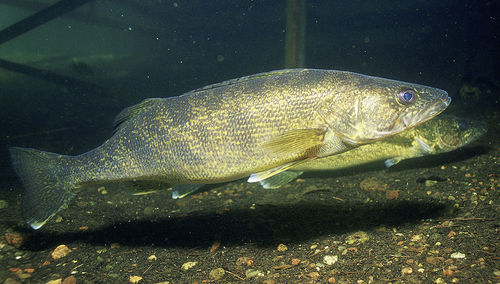
Walleye
Sander vitreus
The golden ghost of the freshwater depths, the Walleye is a master of the night. With its glowing, light-sensitive eyes and powerful predatory instincts, it is one of the most mysterious and sought-after residents of our northern lakes.
Quick Identification
Size
20–30 inches (50–76 cm) in length; 2–20 pounds (0.9–9 kg) in weight
Colors
Golden-olive to brassy-yellow sides with dark mottling; creamy white belly; distinct white patch on the lower lobe of the tail fin.
Key Features
- Large, milky-looking eyes designed for low-light vision
- Two distinct dorsal fins, the first with sharp spines
- White-tipped lower tail lobe
- Long, torpedo-shaped body with sharp teeth
When You’ll See Them
Behavior
Walleye are highly specialized nocturnal predators, named for their unique, light-reflecting eyes (tapetum lucidum). This adaptation allows them to see clearly in murky water and darkness, giving them a significant advantage over their prey. During the day, they typically retreat to deeper, cooler waters or find shelter in weed beds and submerged timber to avoid bright sunlight. Because their eyes are so sensitive, they are often most active during 'walleye chop'—windy conditions that break up the surface of the water and reduce light penetration.
These fish are generally solitary hunters but will congregate in large numbers during the spring spawning season. They travel to shallow, rocky areas in rivers or wind-swept lake shores to lay eggs. While they are a prize for many anglers, they are relatively elusive and cautious, making them a fascinating subject for underwater observation. Unlike some territorial species, walleye are primarily driven by temperature and food availability, often migrating significant distances within a lake system to follow schools of baitfish.
EverydayEarth exclusive
Camera Tips
Capturing high-quality footage of Walleye requires a submersible camera setup or a dock-mounted system. Because Walleye are most active in low-light conditions, your camera needs excellent infrared (IR) capabilities or a high-sensitivity sensor. If you are mounting a camera from a dock or pier, point the lens toward a transition zone where a rocky bottom meets a weed edge. These 'edges' are natural highways for Walleye as they move from deep water into the shallows to hunt at night.
Placement depth is critical. During the summer, Walleye often hang out at depths of 15 to 30 feet, but at night, they may move as shallow as 3 to 5 feet. To increase your chances of a sighting, place your camera near structure—specifically large boulders, submerged logs, or steep drop-offs. If you are using an AI-powered camera with motion detection, ensure the sensitivity is high enough to trigger through the movement of particles in the water, or use a continuous loop recording if the storage allows.
To lure Walleye into the camera’s frame, consider using a 'chum' of crushed minnows or a light-up lure dangled in the field of view. While they aren't attracted to seeds or traditional backyard baits, the vibration and light of a small submerged strobe can pique their curiosity. In the winter, ice-fishing cameras are the gold standard; drop your lens just a few inches off the bottom and keep it stationary. Walleye are often slow-moving in cold water, so patience is key.
Similar Species
Species that look similar or are commonly confused with Walleye.
Sauger
Smaller and more slender with distinct dark spots on the first dorsal fin and no white patch on the tail.
Yellow Perch
Much smaller with vertical dark bars on their sides and lacking the large, glassy eyes of the walleye.
Zander
The European cousin of the walleye; it grows larger and typically lacks the white tip on the lower tail fin.
Frequently Asked Questions
Record Walleye at your habitat
Connect a camera to start building your own species record — AI identifies every visitor automatically.