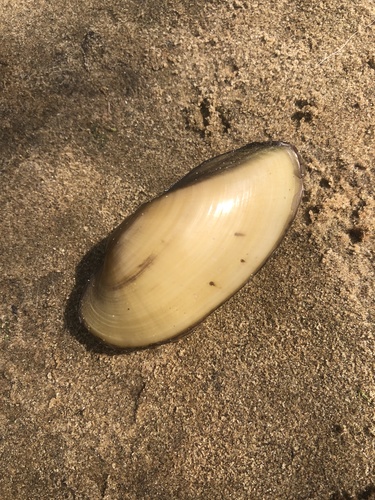
Yellow Sandshell
Lampsilis teres
Glowing with a brilliant golden hue, the Yellow Sandshell is a hidden gem of North American waterways. This master of mimicry uses a fish-like lure to survive, all while silently purifying the rivers it calls home.
Quick Identification
Size
Adults typically reach 10-18 cm (4-7 inches) in length
Colors
Bright, glossy yellow to golden-brown exterior shell; young individuals often feature faint green rays; interior nacre is pearly white or iridescent.
Key Features
- Elongated and elliptical shell shape
- Smooth, shiny yellow periostracum (outer layer)
- Distinct 'sandshell' (thick-shelled) and 'slough' (thin-shelled) forms
- Posterior end is pointed in males and rounded in females
When You’ll See Them
Geographic range
Where Does the Yellow Sandshell Live?
Native to the North American continent, the Yellow Sandshell is primarily found throughout the Mississippi River drainage and various Gulf of Mexico coastal river systems. Its core range spans the central and eastern United States, extending from the Great Lakes region southward to the Gulf, and into several northeastern states in Mexico. While it remains widespread in its primary habitats, it has faced localized extirpation in the northern and eastern fringes of its historical range.
Basemap © OpenStreetMap contributors
Behavior
The Yellow Sandshell is a sedentary filter feeder that spends most of its life partially buried in the riverbed. It plays a vital ecological role by filtering large volumes of water to remove suspended particles, bacteria, and algae, which significantly improves local water clarity. While they may appear stationary, these mussels can use their muscular foot to move slowly through the substrate or to re-bury themselves if displaced by currents.
The most fascinating aspect of their behavior is their reproductive strategy. Female Yellow Sandshells use a specialized mantle flap that mimics the appearance and movement of a small fish or aquatic insect. This 'lure' attracts host fish, primarily the Longnose Gar. When the gar strikes at the lure, the mussel releases its larvae (glochidia), which then attach to the fish's gills to hitchhike and gain nutrients before dropping off to begin their life on the river bottom.
In terms of human interaction, the Yellow Sandshell was historically significant in the pearl button industry due to its thick, high-quality nacre. Today, they serve as 'canaries in the coal mine' for river health, as they are highly sensitive to pollution, siltation, and changes in water temperature. Seeing them in a backyard stream is a strong indicator of a healthy aquatic ecosystem.
EverydayEarth exclusive
Camera Tips
Capturing a Yellow Sandshell on camera requires an underwater approach. If you have a stream or river on your property, look for shallow, sandy areas during periods of low water. Use a waterproof action camera or an AI-powered underwater trail camera. Mount the camera on a weighted base or a short tripod and place it about 12-18 inches away from a known mussel bed. Position the camera at a low 45-degree angle to capture the 'siphons'—the small openings at the back of the shell where the mussel breathes and eats.
Because mussels move very slowly, time-lapse photography is the most effective setting. Set your camera to take a photo every 30 seconds to 2 minutes over several hours. This will allow you to see the mussel slowly 'crawling' through the sand or the rhythmic opening and closing of its shell. If you are lucky, you might even capture the female displaying her fish-like lure to attract host fish.
Lighting is crucial for bringing out the vibrant yellow of the shell. In clear water, natural sunlight between 10 AM and 2 PM provides the best results. If the water is deep or shaded, use a high-CRI (Color Rendering Index) underwater LED light to prevent the footage from looking washed out or overly green. Avoid placing the camera in highly turbulent water, as bubbles and suspended sediment will trigger the motion sensors unnecessarily and obscure the view.
Finally, be patient and mindful of the environment. Do not move or disturb the mussels to 'pose' them for the camera, as this can stress the animal or leave it vulnerable to predators like raccoons. Instead, look for 'tracks' in the sand—long, shallow grooves that indicate where a mussel has recently traveled—and set your camera at the end of a fresh trail.
Similar Species
Species that look similar or are commonly confused with Yellow Sandshell.
Frequently Asked Questions
Record Yellow Sandshell at your habitat
Connect a camera to start building your own species record — AI identifies every visitor automatically.