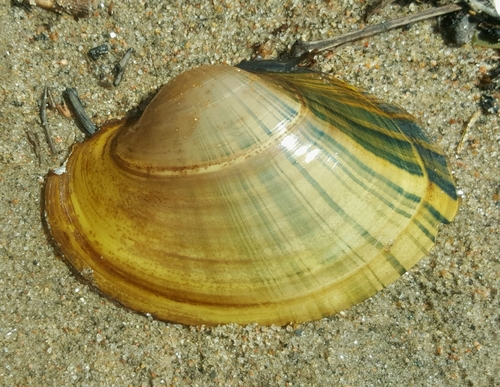
Plain Pocketbook
Lampsilis cardium
The Plain Pocketbook is a master of underwater deception, using a lifelike 'fish lure' to trick predators and ensure the survival of its young.
Quick Identification
Size
Shell length typically ranges from 7.5 to 18 cm (3 to 7 inches)
Colors
Shell is typically yellowish, tan, or yellowish-green with dark green rays; the interior (nacre) is white or bluish-white
Key Features
- Large, oval-shaped and highly inflated shell
- Thin, dark green rays radiating from the beak area
- Female has a specialized mantle flap resembling a small minnow
- Smooth, shiny shell surface in younger specimens
When You’ll See Them
Geographic range
Where Does the Plain Pocketbook Live?
The Plain Pocketbook is a quintessential North American freshwater mussel, natively found throughout the vast Mississippi River and Great Lakes drainage systems. Its core territory stretches across the central and eastern United States, from the northern reaches of New York and the Canadian provinces of Ontario and Manitoba, southward into the river valleys of Arkansas and Tennessee. It is a resilient species that remains widespread in healthy river systems throughout the American Midwest and the Ohio River basin.
Basemap © OpenStreetMap contributors
Behavior
The Plain Pocketbook is a sedentary filter feeder that lives much of its life partially buried in the substrates of rivers and lakes. While it may appear stationary, it is an essential ecological engineer, constantly siphoning water to remove algae, bacteria, and organic debris. This process not only feeds the mussel but significantly improves water clarity and quality for other aquatic residents.
The most fascinating aspect of its behavior is its reproductive strategy. Female Plain Pocketbooks have evolved a highly sophisticated mantle flap that mimics the shape, color, and swimming motion of a small fish, complete with 'eye spots.' By waving this lure, they attract predatory fish like Largemouth Bass. When the fish attempts to eat the lure, the mussel releases its larvae (glochidia), which attach to the fish's gills to hitchhike to new locations before dropping off to begin their lives as independent mussels.
EverydayEarth exclusive
Camera Tips
Observing a Plain Pocketbook with a backyard or trail camera requires an underwater approach. If you have a clear-water stream or river on your property, look for the 'umbos' (the humps at the top of the shell) protruding from the sand or gravel. Place a waterproof action camera on a low-profile weighted mount or a flat stone directly on the riverbed, facing the mussel from a distance of about 12 to 18 inches. Ensure the camera is angled slightly upward to capture the water column above the mussel where the lure will be displayed.
To capture the incredible 'fish lure' behavior, focus your efforts during the late spring and summer months when water temperatures rise. This is the primary period for 'brooding' females to display their mantle flaps. Because the movement of the lure is rhythmic and mimics a small fish, using a camera with a high frame rate (60fps or higher) will provide the smoothest footage of this mimicry in action. Avoid using motion-trigger settings, as the slow movement of the mussel may not trip the sensor; instead, use a time-lapse mode or continuous recording during daylight hours.
Lighting is the biggest challenge for underwater mussel photography. Position your camera in a shallow area where sunlight can penetrate to the bottom. The hours between 10 AM and 2 PM offer the best natural illumination. If the water is slightly turbid, avoid using built-in camera lights, as they will reflect off suspended particles and create 'backscatter.' Instead, rely on the sun's natural rays to highlight the intricate green rays on the shell and the realistic details of the mantle lure.
Similar Species
Species that look similar or are commonly confused with Plain Pocketbook.
Frequently Asked Questions
Record Plain Pocketbook at your habitat
Connect a camera to start building your own species record — AI identifies every visitor automatically.