Fatmucket
Lampsilis siliquoidea
Meet the Fatmucket, a freshwater master of disguise that uses a lifelike 'fish lure' to ensure the survival of its young. This quiet filter feeder is a vital sign of a healthy aquatic ecosystem.
Quick Identification
Size
Typically 3 to 5 inches (7.5 to 12.7 cm) in length; weight varies by shell thickness but usually under 0.5 lbs (225g).
Colors
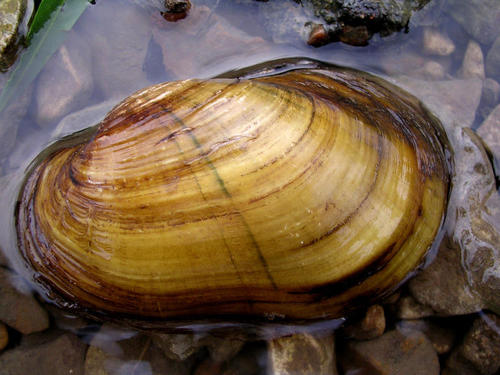
Shell ranges from yellowish-tan to olive-brown, often featuring fine green rays. The interior (nacre) is a brilliant pearly white or bluish-white.
Key Features
- Smooth, oval-to-elliptical shell
- Distinctive dark green rays spreading across the shell
- Pearly white interior nacre
- Prominent mantle lure in females that mimics a small minnow
When You’ll See Them
Geographic range
Where Does the Fatmucket Live?
Where Does the Fatmucket Live? This hardy bivalve is native to North America and possesses one of the broadest distributions of any freshwater mussel on the continent. It thrives throughout the Mississippi River drainage, the Great Lakes basin, and northward into the Hudson Bay drainage, covering a vast area from the Appalachian Mountains to the Rocky Mountains. While predominantly found in the central and northern United States, its range extends significantly into central and western Canada, including provinces like Ontario, Manitoba, and Saskatchewan.
Basemap © OpenStreetMap contributors
Behavior
The Fatmucket is a sedentary but fascinating freshwater mussel that spends most of its life partially buried in the substrate of rivers and lakes. While they may appear inactive to the casual observer, they are constant 'ecosystem engineers,' tirelessly filtering gallons of water every day to remove algae, bacteria, and organic matter. This process not only feeds the mussel but significantly improves water quality for other aquatic life.
Perhaps their most incredible behavior is their reproductive strategy. Female Fatmuckets possess a specialized mantle flap that looks exactly like a small fish, complete with 'eyes' and 'fins.' By waving this lure, they attract predatory fish like Bass or Walleye. When the fish strikes the lure, the mussel releases its larvae (glochidia), which hitch a ride on the fish's gills to disperse throughout the waterway. This unique interaction makes them a marvel of evolutionary mimicry.
EverydayEarth exclusive
Camera Tips
Capturing a Fatmucket on camera requires an underwater approach, making them a perfect subject for a submersible trail camera or a waterproof action camera set to time-lapse mode. For the best results, place your camera in shallow, clear water (1-3 feet deep) where the bottom consists of sand or fine gravel. Look for the 'syphon' openings or the edge of a shell poking out of the mud to identify a high-traffic mussel bed.
The 'holy grail' shot for a Fatmucket is the display of the female’s mantle lure. This usually occurs in late spring and early summer. Position your camera at a low angle, nearly level with the riverbed, to capture the horizontal movement of the lure as it mimics a swimming minnow. Use a macro lens setting if available, as the fine details of the 'fish' mimicry are stunning when viewed up close.
Because mussels move very slowly by pumping their muscular 'foot,' a time-lapse setting is essential to see their behavior. Set your camera to take a photo every 30 seconds over a few hours; when played back, you’ll see the mussel shifting its position in the sand or rapidly closing its shell if a shadow (like a predator) passes over. Ensure you have plenty of natural light, as cloudy water can easily obscure these subtle movements.
Similar Species
Species that look similar or are commonly confused with Fatmucket.
Frequently Asked Questions
Record Fatmucket at your habitat
Connect a camera to start building your own species record — AI identifies every visitor automatically.