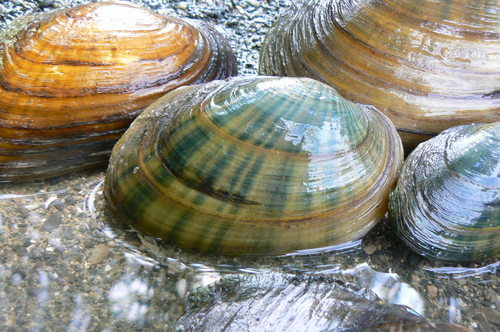
Mucket
Ortmanniana ligamentina
Meet the Mucket, the silent engineer of North America's riverbeds. This heavy-shelled mussel spends its life filtering water and maintaining the health of our greatest freshwater ecosystems.
Quick Identification
Size
Typically 10–18 cm (4–7 inches) in length; shells are heavy and thick-walled.
Colors
Yellowish-brown to dark brown exterior, often with fine green rays; interior nacre is typically a lustrous white.
Key Features
- Large, thick, elliptical shell
- Yellow-brown periostracum with fine green rays radiating from the umbo
- Heavy, well-developed hinge teeth
- Posterior end is rounded in females and more pointed in males
When You’ll See Them
Geographic range
Where Does the Mucket Live?
Native to the freshwater systems of North America, the Mucket is a staple of the Mississippi River drainage and the Great Lakes basin. Its range spans across the central and eastern United States, from the Appalachian Mountains westward to the Great Plains, and extends north into southern Ontario, Canada. It is most densely populated in high-quality river systems within the Ohio, Tennessee, and Cumberland River valleys.
Basemap © OpenStreetMap contributors
Behavior
The Mucket is a sedentary filter feeder that spends the vast majority of its life partially buried in the riverbed. Using a muscular "foot," it anchors itself into gravel or sand to resist the pull of river currents. While they appear stationary, they are constantly active internally, siphoning gallons of water every day to extract oxygen and microscopic food particles. This process makes them vital to their ecosystem, as they act as natural water purifiers.
Their most complex behavior involves a parasitic reproductive cycle. Females lure host fish, such as smallmouth or largemouth bass, to ensure their larvae (glochidia) can attach to the fish's gills. The larvae hitchhike on the fish for several weeks, receiving nutrients and transportation to new parts of the river before dropping off to begin their lives as independent mussels on the substrate.
EverydayEarth exclusive
Camera Tips
Capturing a Mucket on camera requires a specialized underwater approach. Use a waterproof action camera or an underwater trail camera with a high-resolution time-lapse setting. Because these mussels are sedentary, standard motion-triggering won't work. Instead, set your camera to take a photo every 2 to 5 minutes. Over a full day, this will reveal the subtle "breathing" of the mussel as its valves open and its siphons extend to filter water.
Position the camera on a weighted base, such as a flat rock or a small cinder block, to ensure it isn't moved by the river current. Focus the lens on a known mussel bed during periods of clear water and low flow, typically in late summer. Aim the camera at a 45-degree angle toward the substrate. If you are lucky, your time-lapse may also capture host fish like bass or sunfish interacting with the mussels, providing a rare glimpse into their reproductive strategy.
For a unique perspective, try placing your camera near "mussel middens"—piles of empty shells left behind by predators like muskrats or raccoons. A standard trail camera placed on the riverbank overlooking these sites can capture the nocturnal mammals that feed on Muckets. This provides an excellent secondary way to document the species' presence in your local ecosystem without needing specialized underwater housings.
Similar Species
Species that look similar or are commonly confused with Mucket.
Plain Pocketbook
Has a much more rounded, inflated shell compared to the flatter, more elliptical Mucket.
Fatmucket
Typically has a thinner shell and is more elongated with more distinct, darker rays.
Pimpleback
Easily distinguished by the numerous bumps or pustules on the shell surface, which the Mucket lacks.
Frequently Asked Questions
Record Mucket at your habitat
Connect a camera to start building your own species record — AI identifies every visitor automatically.