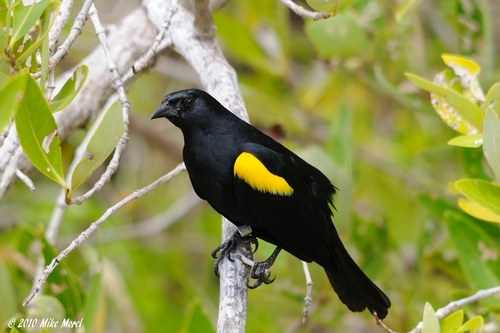
Yellow-shouldered Blackbird
Agelaius xanthomus
Rare and radiant, the Yellow-shouldered Blackbird is a crown jewel of Puerto Rican wildlife. With its sleek black feathers and signature golden 'shoulders,' this endemic songbird is a testament to the island's unique biodiversity.
Quick Identification
Size
Length: 20-23 cm (8-9 in); Wingspan: 30-35 cm (12-14 in); Weight: 38-45 g (1.3-1.6 oz)
Colors
Glossy jet-black body with vibrant yellow shoulder patches (epaulets); both sexes appear identical.
Key Features
- Vibrant yellow patches on the shoulders
- Slender, sharp pointed bill
- Glossy black plumage throughout
- Social behavior, often seen in small groups
When You’ll See Them
Behavior
The Yellow-shouldered Blackbird, known locally in Puerto Rico as the 'Mariquita,' is a highly social and intelligent bird. Unlike many other blackbird species where the male is flashier, both the male and female of this species sport the iconic golden epaulets. They are frequently observed moving in small, synchronized flocks, communicating with a variety of melodious whistles and sharp 'check' calls. Because they are endemic to a small range, they have developed specialized social structures for nesting and foraging.
These birds are predominantly arboreal but aren't afraid to descend to the ground or lower shrubs to forage. In areas where they coexist with humans, they can become quite bold, visiting backyard feeders or water basins. They are particularly known for their agility, often hanging upside down to reach nectar in tubular flowers or to glean insects from the underside of leaves. Their survival is closely tied to coastal ecosystems, particularly mangroves and dry scrub forests.
EverydayEarth exclusive
Camera Tips
To capture the Yellow-shouldered Blackbird, focus your camera efforts on the coastal regions of southwestern Puerto Rico or near the Boquerón Commonwealth Forest. Position your camera at a height of 5 to 7 feet, ideally facing a known perching branch or a native flowering plant like the Agave (Century Plant). These birds are drawn to height and will often survey a yard from a high vantage point before descending to feed or bathe.
Using a water feature is one of the most effective ways to lure this species into your camera's frame. A solar-powered birdbath with a dripper or moving water is particularly attractive. Place the camera 3-4 feet away from the water source with a side-angle to the sun. This ensures the bright yellow shoulder patches aren't washed out by direct glare while highlighting the iridescence of their black feathers.
Because these blackbirds are fast movers, set your AI-powered camera to 'Burst Mode' or high-frame-rate video (60fps). This will help you catch the moment they flare their wings, which is when the yellow epaulets are most visible. If you are using a trail camera, ensure the trigger speed is under 0.5 seconds to capture them as they fly in.
Seasonal timing is key. During the nesting season (April through August), you might witness fascinating social behaviors or the birds carrying nesting materials. If you see them visiting a specific area frequently, avoid moving the camera, as they are creatures of habit and will return to the same foraging spots daily at almost the same time.
Similar Species
Species that look similar or are commonly confused with Yellow-shouldered Blackbird.
Frequently Asked Questions
Record Yellow-shouldered Blackbird at your habitat
Connect a camera to start building your own species record — AI identifies every visitor automatically.