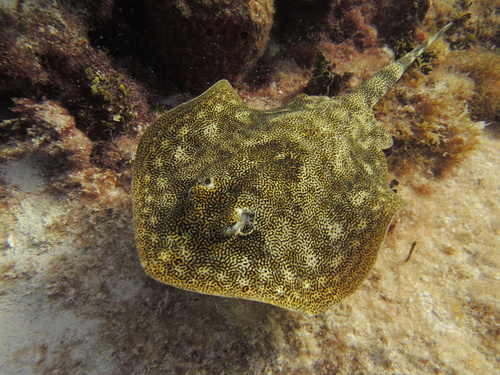
Yellow Stingray
Urobatis jamaicensis
The yellow stingray is a hidden gem of the sandy shallows, sporting a spectacular leopard-like pattern that makes it a master of underwater camouflage.
Quick Identification
Size
Disc width typically 10-14 inches (25-36 cm); total length including tail up to 26 inches (66 cm). Weight ranges from 1.5 to 3 lbs.
Colors
Features a light yellowish or greenish-brown base color overlaid with a dense, complex pattern of dark spots, blotches, or reticulated lines. The underside is uniformly cream or pale yellow.
Key Features
- Distinctly round, disc-shaped body
- Short tail equipped with a small caudal fin at the very tip
- Intricate leopard-like camouflage pattern
- Venomous serrated spine located mid-way down the tail
When You’ll See Them
Behavior
Yellow stingrays are masters of crypsis, spending a significant portion of their lives partially buried in the sand or mud. By using their pectoral fins to wave sediment over their backs, they become nearly invisible to predators and prey alike, leaving only their eyes and spiracles exposed. They are generally docile and shy, preferring to remain stationary or glide slowly over the seabed unless disturbed.
These rays exhibit a unique hunting strategy known as 'tenting.' They will arch their pectoral discs to create a dark, cave-like space underneath their bodies. Small fish or crustaceans, seeking a place to hide, swim into this space only to be trapped and consumed. While they are solitary by nature, they are frequently found in high densities in areas with abundant food sources like seagrass beds and coral reef fringes.
EverydayEarth exclusive
Camera Tips
To capture high-quality footage of a yellow stingray, you will need a dedicated underwater camera setup. An action camera like a GoPro or a specialized underwater trail camera in a waterproof housing is essential. Since these rays are bottom-dwellers, the best camera placement is directly on the seafloor. Use a weighted baseplate or a 'sand screw' mount to keep the camera steady against tidal currents. Position the lens at a slight upward angle or perfectly horizontal to the sand to capture the ray's face and its unique 'hovering' movement.
Because yellow stingrays rely on camouflage, they can be difficult for motion sensors to detect. A better strategy is to use 'Time Lapse' mode, taking a photo every 5-10 seconds, or to use a bait lure to keep the ray in front of the lens. A small mesh bait bag filled with crushed shrimp, squid, or oily fish pieces is highly effective. Anchor the bait bag roughly 18-24 inches in front of the lens; this ensures the ray stays within the camera's focal range while it investigates the scent.
Lighting is the biggest challenge in underwater photography. In shallow water (under 15 feet), midday sun provides the best natural light and brings out the yellow hues of the ray's skin. If you are recording in deeper water or near docks, use an external underwater LED video light. This will prevent the image from looking washed out and blue, revealing the intricate spotted patterns that distinguish this species. Set your camera to a wide-angle view to ensure you capture the full disc of the ray as it passes by.
Look for 'halos' in the sand—circular depressions where the sand looks cleaner or recently disturbed. These are prime spots to set your camera, as they indicate a ray has recently been foraging there. If you are setting up near a reef, place the camera in the sandy 'buffer zone' between the reef edge and the seagrass, as rays frequently patrol these transition zones looking for a meal.
Similar Species
Species that look similar or are commonly confused with Yellow Stingray.
Frequently Asked Questions
Record Yellow Stingray at your habitat
Connect a camera to start building your own species record — AI identifies every visitor automatically.