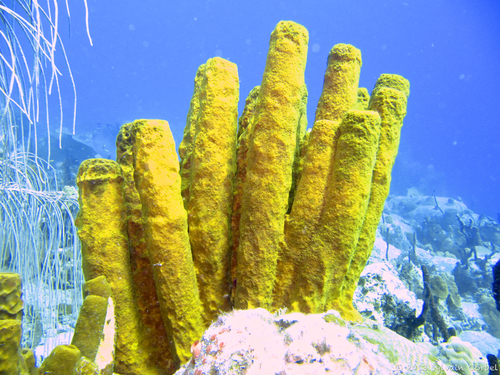
Yellow Tube Sponge
Aplysina fistularis
Rising like golden organ pipes from the ocean floor, the Yellow Tube Sponge is the Caribbean's most iconic living filter. These vibrant towers can pump thousands of liters of water a day, serving as both a reef purifier and a sanctuary for tiny marine life.
Quick Identification
Size
Individual tubes typically reach 1 meter (3.3 feet) in height and 2-10 cm (0.8-4 inches) in diameter.
Colors
Bright golden-yellow to mustard-yellow; turns a distinct dark purple or black when dying or removed from water.
Key Features
- Tall, hollow cylindrical tubes
- Bright yellow coloration
- Single large opening (osculum) at the top of each tube
- Pitted surface with small, conical bumps
When You’ll See Them
Geographic range
Where Does the Yellow Tube Sponge Live?
The Yellow Tube Sponge is a hallmark species of the Western Atlantic's tropical marine ecosystems. It is most commonly found throughout the Caribbean Sea, the Bahamas, and the coral-rich waters of the Florida Keys. Its range extends across the Gulf of Mexico and follows the coastlines of Central America down to the northern shores of South America, including Brazil. While it prefers clear, high-salinity water, it can be found in a variety of reef zones, provided there is a hard surface for initial attachment.
Basemap © OpenStreetMap contributors
Behavior
The Yellow Tube Sponge is a sessile creature, meaning it spends its entire adult life anchored to the same spot on the reef. It acts as a high-volume water pump, drawing massive amounts of seawater through its porous walls to filter out microscopic nutrients. This constant flow not only provides food but also oxygenates the sponge's tissues. Despite its lack of mobility, it is a highly active biological filter that can process thousands of liters of water daily.
Because it cannot flee from predators, this sponge has evolved a chemical defense strategy. It produces potent secondary metabolites that make it taste bitter or toxic to most reef fish, such as parrotfish or wrasses. However, it serves as a vital micro-habitat for other reef dwellers; the hollow interior of the tubes often hosts small crabs, brittle stars, and gobies that use the sponge for protection from the open ocean.
EverydayEarth exclusive
Camera Tips
Capturing the Yellow Tube Sponge with an underwater camera requires a focus on stability and color correction. Because sponges are stationary, they are the perfect subject for high-resolution stills or time-lapse photography. If you are using a camera like a GoPro on a reef-monitoring rig, use a weighted tripod or a suction mount to prevent surge or currents from blurring the shot. Position the camera at a slight upward angle to emphasize the height of the tubes against the blue water column.
Color loss is a major challenge when filming this species. As you go deeper, red and yellow light is absorbed by the water, making the sponge look dull or greenish. To restore its natural golden-yellow glow, use a red filter for shallow depths (under 10 meters) or external video lights (LED sea-lights) for deeper placements. Aim the lights from a 45-degree angle to the side to highlight the 'conuli' (bumps) on the surface texture without washing out the detail with direct glare.
For those using AI-powered cameras to track reef health, the Yellow Tube Sponge is an excellent indicator species. Set your camera to take high-resolution intervals rather than continuous video to conserve battery. Look for 'osculum' activity—sometimes you can visualize the water being pumped out of the top opening by capturing the shimmering effect of different water densities or small particles exiting the tube. This provides a fascinating look into the 'breathing' of the reef.
Seasonally, the sponge looks much the same year-round, but water clarity is best during the dry season (typically December to May in the Caribbean). Avoid placing cameras near the sponge during high-sediment events like storms, as the sponge may contract slightly or become covered in silt, which obscures its features. If you are lucky, your camera might catch a Hawksbill sea turtle, one of the few animals known to occasionally graze on these chemically-protected sponges.
Similar Species
Species that look similar or are commonly confused with Yellow Tube Sponge.
Frequently Asked Questions
Record Yellow Tube Sponge at your habitat
Connect a camera to start building your own species record — AI identifies every visitor automatically.