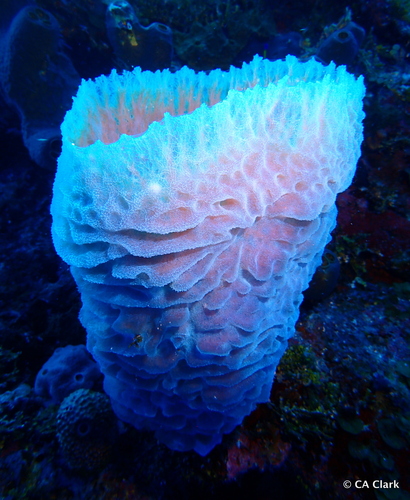
Azure Vase Sponge
Callyspongia plicifera
A living neon masterpiece of the Caribbean, the Azure Vase Sponge is famous for its glowing blue hues and its role as a vital architect of the reef's hidden world.
Quick Identification
Size
Height up to 45 cm (18 inches) with a diameter of roughly 12-20 cm (5-8 inches)
Colors
Brilliant fluorescent blue, iridescent purple, or vibrant pinkish-mauve
Key Features
- Distinctive chalice or vase-like shape
- Exterior surface covered in deep pits, ridges, and honeycomb-like convolutions
- Large central opening (osculum) at the top
When You’ll See Them
Geographic range
Where Does the Azure Vase Sponge Live?
The Azure Vase Sponge is native to the tropical Western Atlantic Ocean, with its highest population density centered around the Bahamas. Its range extends throughout the Caribbean Sea, including the waters surrounding the Greater and Lesser Antilles, the Florida Keys, and the Gulf of Mexico. It is a signature species of the West Indian reef province, thriving in deep-water environments where it finds the stable, warm temperatures and steady currents it requires to thrive.
Basemap © OpenStreetMap contributors
Behavior
The Azure Vase Sponge is a sessile marine organism, meaning it remains anchored to the same spot on the reef for its entire adult life. It acts as a highly efficient biological filter, constantly pumping seawater through its porous body walls to extract nutrients. This pumping action is so powerful that a large sponge can process thousands of liters of water daily, playing a critical role in maintaining the clarity and health of the surrounding coral reef ecosystem.
While they may appear static, these sponges are bustling hubs of activity. They provide a structural micro-habitat for a variety of small reef residents, including neon gobies, snapping shrimp, and brittle stars, which often hide within the central cavity or tucked into the deep exterior grooves. They lack a nervous system, but they can slowly regulate their water flow in response to changes in sediment levels or physical touch by contracting their pores.
EverydayEarth exclusive
Camera Tips
Capturing the Azure Vase Sponge requires a specialized underwater setup, such as a GoPro in a dive housing or a permanent reef-cam rig. Because this species lives at depths where the water filters out the red end of the light spectrum, the sponge often appears a dull, muddy gray on standard cameras. To reveal its true, brilliant azure blue, you must use high-powered underwater video lights with a high Color Rendering Index (CRI) or apply a red color-correction filter to your lens to restore the natural balance.
For the best composition, mount your camera on a weighted underwater tripod or a stable rock crevice about two feet away from the sponge. Angle the camera slightly upward toward the rim of the vase. This perspective captures the majestic silhouette of the sponge against the ambient light from the surface and allows you to film the 'osculum'—the large top opening—where you are most likely to see commensal shrimp or small fish darting in and out of the sponge’s interior.
If you are setting up a long-term monitor, be mindful of biofouling. Algae and small barnacles can quickly cover a camera lens in tropical waters. Using a wiper system or a non-toxic clear foul-release coating on the lens port can help maintain clarity. Because these sponges are stationary, they are excellent subjects for time-lapse photography, which can reveal the subtle contractions of the sponge or the constant 'parade' of reef life that uses the sponge as a landmark.
Lastly, ensure your camera is secured tightly against the surge. Even at 30 meters deep, significant swells can create a 'back and forth' motion that results in blurry footage. Use heavy lead weights or stainless steel zip-ties to anchor your rig to dead reef substrate, taking great care not to damage the living sponge or nearby corals during the installation process.
Similar Species
Species that look similar or are commonly confused with Azure Vase Sponge.
Frequently Asked Questions
Record Azure Vase Sponge at your habitat
Connect a camera to start building your own species record — AI identifies every visitor automatically.