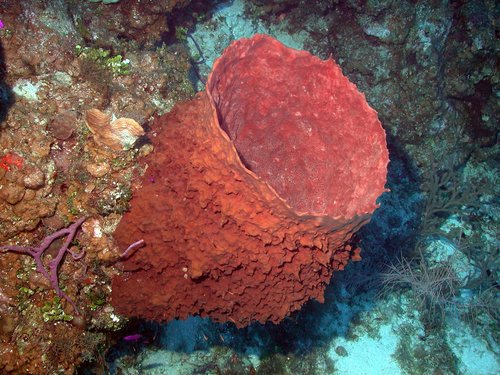
Giant Barrel Sponge
Xestospongia muta
The 'Redwood of the Reef,' this ancient giant can live for two millennia, acting as a massive living filter that sustains the crystal-clear waters of the Caribbean.
Quick Identification
Size
Diameter up to 1.8 metres (6 feet); height can reach 2.4 metres (8 feet)
Colors
Brownish-red, brownish-gray, or deep purple; can appear white when bleached
Key Features
- Massive barrel or cauldron shape
- Hard, stony, or leathery exterior texture
- Large central opening (osculum) at the top
- Deeply pitted and craggy outer surface
When You’ll See Them
Geographic range
Where Does the Giant Barrel Sponge Live?
The Giant Barrel Sponge is a signature species of the Caribbean Sea and the wider tropical Western Atlantic. It is commonly found throughout the Florida Keys, the Bahamas, and the Gulf of Mexico, extending south through the West Indies to the coast of Brazil. These sponges are a dominant feature of reef ecosystems in these warm, clear tropical waters.
Basemap © OpenStreetMap contributors
Behavior
The Giant Barrel Sponge is often referred to as the 'Redwood of the Reef' due to its massive size and incredible longevity. Some of the largest specimens in the Caribbean are estimated to be over 2,000 years old. As a sessile organism, it remains fixed to the reef floor for its entire adult life, acting as a giant biological pump. It processes thousands of liters of seawater every day, filtering out microscopic food particles and oxygen, which significantly contributes to the clarity of the surrounding water.
While the sponge itself is stationary, it is a bustling hub of activity for other marine life. The large central cavity, or atrium, provides a safe harbor for various species of fish, crabs, and shrimp. Though it has no brain or nervous system, it can respond to environmental changes and is known to participate in mass spawning events, where it releases clouds of reproductive cells into the water in a process sometimes called 'smoking.'
EverydayEarth exclusive
Camera Tips
Capturing the Giant Barrel Sponge on an underwater camera requires careful attention to lighting and stability. Because these sponges live at depths where red light is quickly absorbed by the water, they often appear a dull gray in photos. To reveal their true brownish-red or purple hues, you must use a strong external strobe or video light. Positioning your lights at a 45-degree angle from the camera will help highlight the rugged, craggy texture of the sponge's outer walls without creating 'backscatter' from particles in the water.
When setting up a stationary camera or a 'reef-cam,' placement is vital for the health of the ecosystem. Never mount a camera directly onto the sponge or nearby live coral. Instead, use a weighted tripod or a sand-anchor system placed on an adjacent sandy patch. Aim the camera slightly upward to capture the towering silhouette of the sponge against the lighter surface water; this perspective emphasizes its 'barrel' shape and makes for a much more dramatic shot than looking straight down at it.
For those interested in the 'action' around the sponge, focus your lens on the rim of the osculum (the top opening) or the deep crevices on the sides. These areas are frequently visited by cleaner shrimp, gobies, and neon wrasses. If you are lucky enough to be filming during a full moon in late summer, you might capture a spawning event. Set your camera to high-definition video or a rapid time-lapse to record the 'smoke' of gametes as they are pumped out of the central cavity.
Similar Species
Species that look similar or are commonly confused with Giant Barrel Sponge.
Frequently Asked Questions
Record Giant Barrel Sponge at your habitat
Connect a camera to start building your own species record — AI identifies every visitor automatically.