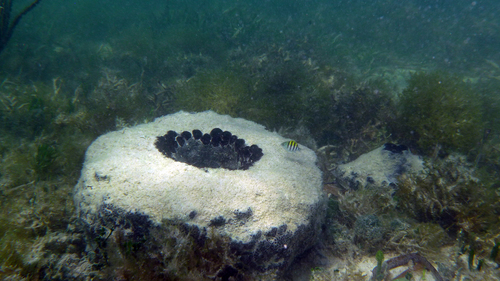
Loggerhead Sponge
Spheciospongia vesparium
The 'apartment building' of the ocean, the Loggerhead Sponge is a massive, barrel-shaped filter feeder that provides a home for thousands of tiny sea creatures.
Quick Identification
Size
Diameter typically 30-100 cm (12-40 in), height up to 60 cm (24 in)
Colors
Dull charcoal gray, black, or dark brown exterior; interior tissue is usually a lighter tan or cream color
Key Features
- Massive barrel or flattened 'loaf' shape
- Cluster of large, visible openings (oscules) on the top surface
- Tough, leathery, and rubbery texture that is hard to compress
- Often encrusted with silt or sand in seagrass habitats
When You’ll See Them
Geographic range
Where Does the Loggerhead Sponge Live?
The Loggerhead Sponge is a signature species of the tropical Western Atlantic. It is most abundantly found throughout the Caribbean Sea, the Bahamas, and the Gulf of Mexico. Its range extends northward along the Atlantic coast of Florida and the Florida Keys, reaching as far as Bermuda, and southward along the coast of Central America to the northern shores of South America. Because it thrives in shallow, light-filled waters, it is a common sight for snorkelers and divers along the shelf of the Yucatan Peninsula and the Antilles.
Basemap © OpenStreetMap contributors
Behavior
The Loggerhead Sponge is one of the most ecologically significant organisms in the Western Atlantic, functioning less like a single animal and more like a bustling underwater apartment complex. While it lacks a nervous system or muscles, it is a master of water engineering. By beating millions of tiny flagella, it creates a vacuum that pulls water through its porous body, filtering out microscopic food particles. A single large specimen can process thousands of liters of water every day, playing a vital role in maintaining water clarity on the reef.
This sponge is famous for its symbiotic relationships. It is the primary home for the snapping shrimp (Synalpheus regalis), which live in the sponge's internal canals in large, social colonies similar to bees or ants. Hundreds, sometimes thousands, of these tiny crustaceans, along with small crabs, worms, and brittle stars, spend their entire lives protected within the sponge's mass. While it is toxic to most fish to prevent being eaten, it is a favorite snack for Hawksbill sea turtles and certain specialized angelfish.
EverydayEarth exclusive
Camera Tips
Capturing the Loggerhead Sponge requires an underwater camera setup, as these massive invertebrates are entirely aquatic. For the best results, use a wide-angle lens to capture the sponge's impressive barrel-like scale relative to the surrounding reef or seagrass. Because they often grow in shallow water (under 10 meters), you can rely on natural light, but a red filter is highly recommended to bring out the natural browns and grays that otherwise look washed out and blue at depth.
To truly use an AI-powered camera to its full potential, focus on the top of the sponge where the large oscules (openings) are located. This is where you will see the 'tenants' of the sponge. Small gobies often sit on the rim, and if you stay still, you might catch the antennae of snapping shrimp or the arms of brittle stars poking out. Set your camera for a close-up macro shot of these openings during the daytime when the light can penetrate the canals.
If you are setting up a stationary underwater camera for time-lapse, choose an area with moderate current. You can observe the 'ventilation' effect by watching how particles move toward the base of the sponge and are expelled from the top. Additionally, keep an eye out for Hawksbill sea turtles. These turtles are the Loggerhead Sponge's primary predator; a camera positioned near a large sponge has a high probability of capturing a turtle coming in for a meal, as they will often return to the same sponge until it is significantly grazed down.
Similar Species
Species that look similar or are commonly confused with Loggerhead Sponge.
Frequently Asked Questions
Record Loggerhead Sponge at your habitat
Connect a camera to start building your own species record — AI identifies every visitor automatically.