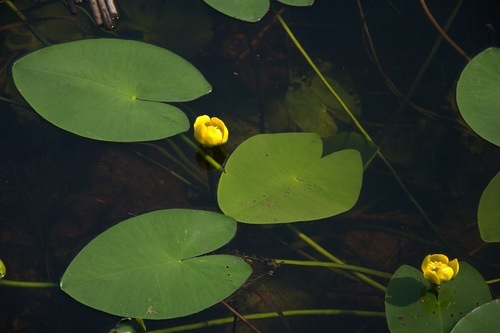
yellow water-lily
Nuphar lutea
Often called the Brandy-bottle for its unique scent, the yellow water-lily is a master of the wetlands. Its golden, cup-shaped blooms and massive floating leaves create a thriving micro-city for frogs, fish, and dragonflies.
Quick Identification
Size
Floating leaves 15-40 cm (6-16 in) long; flowers 4-6 cm (1.5-2.5 in) in diameter; stems can reach depths of up to 3 meters (10 ft).
Colors
Bright waxy yellow flowers; deep emerald green leathery leaves; stems and underside of leaves can be reddish-green.
Key Features
- Cup-shaped yellow flowers with a distinct 'brandy bottle' scent
- Large heart-shaped floating leaves with a deep notch at the base
- Central green disk in the flower resembling a bottle stopper
- Submerged leaves that are thin, crinkled, and translucent
- Thick, sponge-like underwater rhizomes.
When You’ll See Them
Behavior
The yellow water-lily is a perennial aquatic plant that acts as a cornerstone of freshwater ecosystems. Unlike many other lilies, its flowers are held slightly above the water's surface on thick stalks. It is often nicknamed the 'Brandy-bottle' because its flowers emit a faint, alcoholic fragrance that is particularly attractive to specialized pollinating flies and beetles.
As the sun rises, the flowers gradually open to reveal their golden petals and central disk, closing back up as evening approaches. Below the surface, the plant grows from a massive, creeping rhizome anchored in the mud, which can live for decades. These lilies provide vital 'behavioral support' for other wildlife, offering shade that keeps water temperatures stable and providing structural platforms for amphibians and insects.
EverydayEarth exclusive
Camera Tips
Capturing the yellow water-lily on camera requires a shift from motion-triggering to time-lapse photography. To witness the 'waking up' of the pond, set your camera to take a photo every 5 to 10 minutes from sunrise to mid-afternoon. This will allow you to create a stunning sequence of the cup-shaped flowers blooming and the leaves shifting on the water's surface. Ensure your camera is mounted on a stable stake or pier near the water's edge; avoid floating mounts if you want a crisp time-lapse, as wind will cause the frame to drift.
Because the leaves are highly reflective, glare can be a major issue. Position your camera so the sun is behind it or use a lens hood to minimize 'blow-out' on the waxy green surfaces. If you are using a motion-activated trail camera, aim it across a cluster of lily pads rather than directly at a single flower. This increases your chances of capturing the wildlife the plant attracts, such as dragonflies perching on the leaves or frogs using them as hunting platforms.
Low-angle shots are the most dramatic for this species. Try to mount your camera just a few inches above the water level to get a 'frog's eye view' of the yellow blooms. This perspective emphasizes the height of the flower stalks and the texture of the lily pads. During the peak summer months, look for 'pollinator activity'—small beetles often crawl inside the flowers, and a high-resolution macro setting (if your camera supports it) can capture these hidden interactions.
Similar Species
Species that look similar or are commonly confused with yellow water-lily.
Frequently Asked Questions
Record yellow water-lily at your habitat
Connect a camera to start building your own species record — AI identifies every visitor automatically.