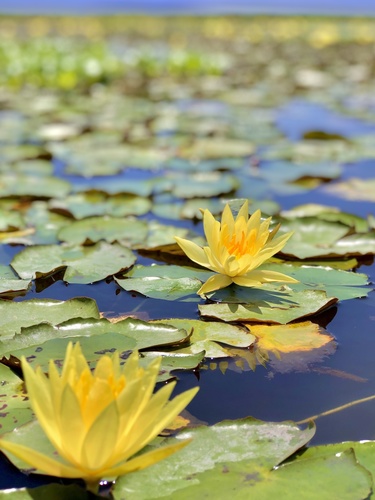
Yellow Waterlily
Nymphaea mexicana
Transforming ponds into liquid gold, the Yellow Waterlily is a sun-loving aquatic marvel known for its brilliant lemon-hued blooms and unique 'banana' roots. It is a vital sanctuary for backyard pond life, offering shade for fish and a landing pad for colorful dragonflies.
Quick Identification
Size
Flowers: 6-12 cm (2.5-5 in) diameter; Leaves: 10-25 cm (4-10 in) wide; Stems: up to 2 m (6.5 ft) long
Colors
Bright lemon-yellow flowers with orange-yellow centers; olive-green leaves often featuring purple or brown blotches
Key Features
- Brilliant star-shaped yellow flowers that rise above the water
- Circular green leaves with a deep V-shaped notch
- Unique 'banana-shaped' tuberous roots
- Purple-to-brown mottling on the surface of floating pads
When You’ll See Them
Behavior
In terms of growth, this species is highly energetic. It spreads through a combination of seeds, creeping stolons, and specialized 'banana' tubers. These tubers can detach and float to new areas, allowing the plant to colonize distant parts of a pond or waterway. While it provides essential shade and hiding spots for fish and frogs, its vigorous nature means it can quickly cover the surface of still water if not managed in a garden setting.
EverydayEarth exclusive
Camera Tips
Water-based photography can be tricky for motion-activated cameras because wind-blown ripples or shifting lily pads can cause 'false' triggers. To mitigate this, use a camera with 'Zone' detection if available, or set the sensitivity to low. If your goal is to capture the wildlife that visits the lily, such as dragonflies or frogs using the pads as hunting platforms, focus your camera on a single, healthy bloom that is closest to the shore. A side-on angle is often better than a top-down view, as it provides a sense of depth and shows the stalk lifting the flower above the water line.
Exposure management is critical because the bright yellow of the Nymphaea mexicana can easily become 'blown out' (losing all detail) in direct midday sunlight. If your camera settings allow, dial down the exposure compensation slightly (-0.5 or -1.0). The best 'hero shots' occur during the 'golden hour'—shortly after the flowers open in the morning or just before they close in the afternoon—when the light is soft and warm. Finally, ensure your camera housing is secure; the humid environment of a pond edge can lead to lens fogging, so using an anti-fog insert inside the camera case is highly recommended.
Similar Species
Species that look similar or are commonly confused with Yellow Waterlily.
Frequently Asked Questions
Record Yellow Waterlily at your habitat
Connect a camera to start building your own species record — AI identifies every visitor automatically.