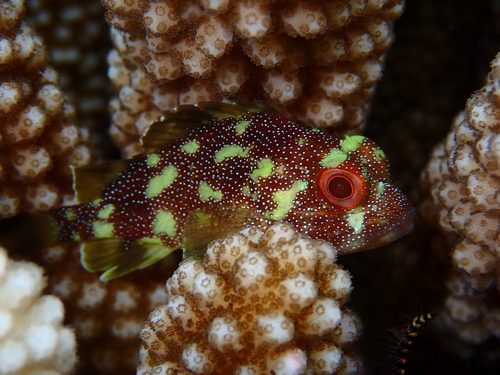
Yellowspotted Scorpionfish
Sebastapistes cyanostigma
A hidden gem of the coral reef, the Yellowspotted Scorpionfish combines dazzling pink and gold patterns with a secretive, nocturnal lifestyle. Found deep within branching corals, this tiny predator is a master of the underwater ambush.
Quick Identification
Size
A small species reaching up to 10 cm (4 inches) in total length.
Colors
Base color is pinkish-red to bright orange, covered in numerous small, distinct yellow spots and occasional white or blueish-white blotches.
Key Features
- Bright yellow spots across a pink or orange body
- Venomous dorsal spines for protection
- Compact, stocky build typical of the Scorpaenidae family
- Hides exclusively within branching coral structures
When You’ll See Them
Geographic range
Where Does the Yellowspotted Scorpionfish Live?
Where Does the Yellowspotted Scorpionfish Live? This vibrant marine species is widely distributed across the tropical waters of the Indo-Pacific. Its native range begins in the Red Sea and along the eastern coast of Africa, extending across the Indian Ocean to the islands of the Central Pacific, including the Line and Marquesas Islands. It is commonly observed in the coral-dense regions of Indonesia, the Philippines, and northern Australia, stretching as far north as the subtropical waters of southern Japan.
Basemap © OpenStreetMap contributors
Behavior
The Yellowspotted Scorpionfish is a master of reef-based camouflage and extreme site fidelity. It is almost exclusively found nestled within the protective branches of cauliflower corals (Pocillopora) and brush corals (Stylophora). During the daylight hours, it remains nearly motionless deep inside these coral heads, making it incredibly difficult for divers or predators to spot. It is a solitary and highly territorial fish, often claiming a single coral colony as its permanent home for long periods.
As a nocturnal hunter, this species becomes more active as the sun sets. It is a classic ambush predator, relying on its disruptive coloration to blend into the complex patterns of the reef. When a small crustacean or fish wanders too close, the scorpionfish uses a vacuum-like strike, expanding its mouth rapidly to swallow the prey whole. Despite its beautiful appearance, it possesses venomous spines on its dorsal, anal, and pelvic fins, which serve as a powerful deterrent against larger reef predators.
EverydayEarth exclusive
Camera Tips
Capturing the Yellowspotted Scorpionfish requires a specialized approach since they are found underwater and usually tucked deep within coral branches. If you are using a fixed underwater camera or a trail-style housing for marine monitoring, the most critical factor is placement. You must identify a healthy Pocillopora coral head; look for the tiny yellow dots of the fish peeking through the branches. Position your camera on a weighted tripod at eye-level with the mid-section of the coral, keeping a distance of about 12-18 inches to allow for macro-focusing while capturing the fish's environment.
Because these fish are most active at night and live in dark crevices, lighting is your biggest challenge. For AI-powered cameras, use a low-intensity, diffused red light or a 'fill' light to avoid washing out the fish's brilliant pink and yellow hues. White light can often cause the coral branches to cast harsh shadows that confuse motion-detection sensors. Set your camera to a wide aperture (f/2.8 or f/4) to help isolate the fish from the complex, distracting background of the coral reef.
Since the Yellowspotted Scorpionfish is an ambush predator, it stays still for long periods. To capture a strike, set your camera's trigger to high sensitivity or use a 'pre-roll' video feature if available. The most engaging footage occurs when the fish moves from the inner branches to the outer edge of the coral at dusk. Avoid moving the camera once placed; these fish are sensitive to changes in their immediate environment and may retreat deeper into the coral if they perceive a new, shifting shadow.
Similar Species
Species that look similar or are commonly confused with Yellowspotted Scorpionfish.
Frequently Asked Questions
Record Yellowspotted Scorpionfish at your habitat
Connect a camera to start building your own species record — AI identifies every visitor automatically.