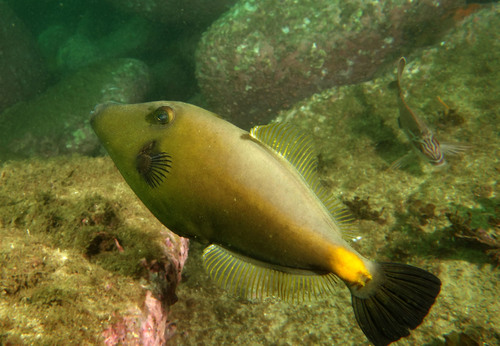
Yellowstriped Leatherjacket
Meuschenia flavolineata
The Yellowstriped Leatherjacket is a master of the southern reefs, easily recognized by its golden racing stripes and its clever ability to 'lock' itself into safety within rocky crevices.
Quick Identification
Size
Grows to approximately 30 cm (12 inches) in length; weighs between 0.3-0.7 kg (0.6-1.5 lbs)
Colors
Olive-green to brownish body with 3-4 distinct horizontal yellow stripes; males may show bright blue streaks near the fins
Key Features
- Retractable first dorsal spine above the eyes
- Distinctive horizontal yellow-gold stripes along the body
- Rough, sandpaper-like skin texture
- Small, powerful mouth with beak-like teeth
When You’ll See Them
Geographic range
Where Does the Yellowstriped Leatherjacket Live?
The Yellowstriped Leatherjacket is a native specialist of the temperate waters surrounding the southern half of Australia. Its range extends from the coastal waters of New South Wales, wrapping around the southern coastline through Victoria and Tasmania, and reaching up to the southwestern shores of Western Australia. It is a signature resident of the Great Southern Reef, thriving in cool, nutrient-rich oceanic environments.
Basemap © OpenStreetMap contributors
Behavior
The Yellowstriped Leatherjacket is a diurnal species, meaning it is most active during daylight hours. It is frequently seen navigating the complex structures of rocky reefs and seagrass meadows with a unique 'rowing' motion, powered by its soft dorsal and anal fins rather than its tail. While they can be solitary, they are often found in pairs or small groups, maintaining a home range where they forage throughout the day.
These fish are relatively bold and curious, making them excellent subjects for underwater observation. When threatened, they utilize a specialized defense mechanism: they retreat into a crevice and lock their large dorsal spine into an upright position, wedging themselves securely so that predators cannot pull them out. This spine, combined with their extremely tough, leathery skin, makes them a difficult meal for larger marine hunters.
EverydayEarth exclusive
Camera Tips
To capture high-quality footage of a Yellowstriped Leatherjacket, you will need a waterproof action camera or a dedicated underwater housing. The best placement is near a structural transition zone—where a rocky reef meets a seagrass bed. Mount your camera to a weighted base or a pier piling at a depth of 2 to 5 meters. Because these fish are naturally inquisitive, they will often swim directly up to the lens to investigate their own reflection, providing excellent close-up opportunities.
Use a wide-angle lens setting to capture their environment, but ensure you have adequate light. In the green-tinted temperate waters where they live, a red filter can help bring out the vibrant yellow of their stripes and the subtle blue markings on the males. If you are filming under a jetty, position your camera to catch the 'god rays' filtering through the pylons, which creates a dramatic backdrop for the fish as they forage.
If you want to keep them in frame for longer, consider placing a mesh bag filled with crushed mussel shells or fish scraps within the camera's field of view. The leatherjacket's beak-like teeth are designed for nibbling, and watching them work at a bait bag offers a fascinating look at their feeding mechanics. Set your camera to a high frame rate (at least 60 fps) to smooth out the undulating movements of their fins, which can appear blurred at lower shutter speeds.
Similar Species
Species that look similar or are commonly confused with Yellowstriped Leatherjacket.
Frequently Asked Questions
Record Yellowstriped Leatherjacket at your habitat
Connect a camera to start building your own species record — AI identifies every visitor automatically.