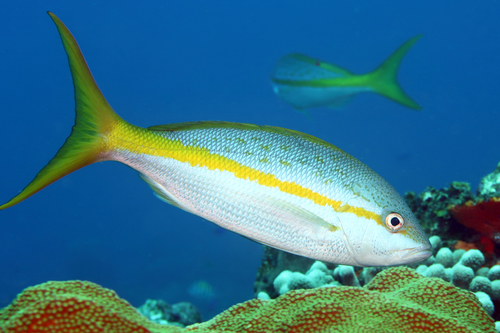
Yellowtail Snapper
Ocyurus chrysurus
A flash of gold in the blue Atlantic, the Yellowtail Snapper is one of the most vibrant and energetic residents of the coral reef. Known for its distinct yellow stripe and wandering schools, it is a prized sight for both coastal observers and underwater photographers.
Quick Identification
Size
Typically 12-16 inches (30-40 cm) long, reaching up to 34 inches (86 cm); weighs up to 11 lbs (5 kg).
Colors
Distinctive bright yellow horizontal stripe running from the snout to a deeply forked yellow tail; olive-to-bluish back with yellow spots and a silvery-white underbelly.
Key Features
- Bright yellow, deeply forked tail
- Continuous yellow stripe from eye to tail
- Olive or bluish back with small yellow spots
- Streamlined, slender body compared to other snapper species
When You’ll See Them
Sightings on EverydayEarth
Jul 3, 2026
A vibrant coral reef scene showing diverse fish activity. A large school of small Blue Chromis hovers in the blue water above the reef, while a Yellowtail Snapper and several Creole Wrasse swim across the foreground and middle ground. The reef itself is densely populated with various hard corals, sponges, and sea fans that sway gently in the current.
Jul 3, 2026
A vibrant reef scene filled with activity. A Creole Wrasse swims across the upper center of the frame, while several Atlantic Sergeant Majors are visible near the coral on the left. Numerous small Blue Chromis hover in the water column above the reef, and a Yellowtail Snapper is seen passing through the scene on the right.
Jun 16, 2026
A pair of Spotted Eagle Rays glides gracefully through the open water, showcasing their striking white-spotted patterns. The camera then captures a busier scene along the reef where a group of Nurse Sharks is seen swimming together. They are surrounded by active schools of fish, including Yellowtail Snappers and Bar Jacks, moving among the colorful coral and sea fans.
May 27, 2026
A vibrant coral reef scene teeming with life. A large Grey Angelfish slowly swims across the center of the frame, while a Yellowtail Snapper passes through the lower right near the reef floor. Numerous small Blue Chromis and Atlantic Sergeant Majors are seen darting among the swaying sea fans and coral heads in the clear blue water.
May 13, 2026
The nighttime reef scene is active with various fish species. A Bar Jack is seen swimming in the upper portion of the frame, followed shortly by a Yellowtail Snapper that swims closer to the camera, showcasing its vibrant yellow tail. Numerous tiny planktivorous fish or organisms dart rapidly through the water column, illuminated by the camera's light.
Behavior
The Yellowtail Snapper is a highly active and gregarious species, often found in large, shimmering schools hovering just above coral reefs or shipwrecks. Unlike many other snapper species that prefer to hide in holes or crevices during the day, Yellowtails are semi-pelagic, meaning they spend much of their time swimming in the mid-water column. They are known for their curiosity and speed, making them a favorite among snorkelers and divers.
While they are active during the day, they are primarily nocturnal foragers. As the sun sets, the schools often disperse to hunt for smaller prey. In areas with high human activity, such as public piers or popular dive spots, they can become quite bold, sometimes approaching humans in hopes of a handout, though they remain wary enough to dart away at any sudden movement.
EverydayEarth exclusive
Camera Tips
Capturing the Yellowtail Snapper requires an underwater camera setup, such as a GoPro or a specialized marine trail cam. To get the best footage, mount your camera to a weighted tripod or a fixed structure like a dock piling or a submerged reef edge. Position the lens at a slight upward angle toward the surface; this allows the sunlight to illuminate the snapper's brilliant yellow stripe and forked tail against the blue water, creating a high-contrast, professional look.
Because Yellowtails are mid-water swimmers, baiting is highly effective for drawing them into the camera's frame. Use a mesh chum bag filled with ground fish or shrimp secured about 3-5 feet away from the lens. This creates a 'scent trail' that will attract a school rather than just a single fish. Ensure the bait bag is positioned so it doesn't obstruct the view but stays within the current to lead the fish directly across the camera’s field of vision.
Timing is critical for lighting. The best footage is usually captured between 10 AM and 2 PM when the sun is directly overhead, penetrating the water column with the most clarity. If you are filming near a dock or pier, try to capture them during an incoming tide, which often brings clearer oceanic water and more active feeding behavior. Set your camera to a high frame rate (60fps or higher) to capture their quick, darting movements in smooth slow-motion during playback.
Similar Species
Species that look similar or are commonly confused with Yellowtail Snapper.
Frequently Asked Questions
Record Yellowtail Snapper at your habitat
Connect a camera to start building your own species record — AI identifies every visitor automatically.