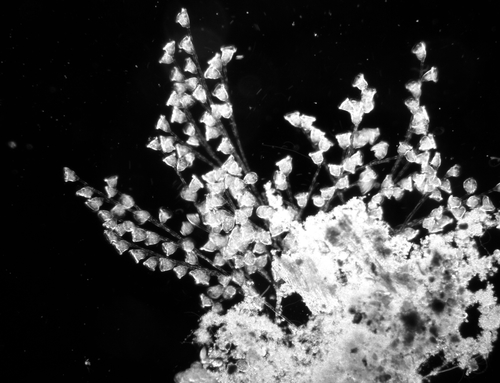
Zoothamnium arbuscula
Zoothamnium arbuscula
Meet the 'Bonsai Tree' of the microbial world. Zoothamnium arbuscula is a stunning colonial organism that brings high-speed action and intricate beauty to the hidden corners of your backyard pond.
Quick Identification
Size
Colonies reach 2–3 mm (0.08–0.12 in) in height; individual bell-shaped cells are 60–100 micrometers.
Colors
Translucent, milky white, or light gray; colonies appear as delicate, shimmering silver tufts.
Key Features
- Tree-like branching colonial structure
- Rapidly contractile common stalk that collapses the whole colony
- Bell-shaped individual cells (zooids) at the ends of branches
- Visible to the naked eye as white 'fuzz' on submerged objects
When You’ll See Them
Behavior
Zoothamnium arbuscula is a fascinating colonial ciliate that functions like a singular, coordinated organism. While it looks like a tiny underwater tree, it is actually a community of single-celled organisms called zooids. Each 'branch' of the colony supports individual bell-shaped cells that use hair-like cilia to create vortexes, drawing in bacteria and organic particles for food. One of their most remarkable behaviors is their collective contraction; when the colony senses a vibration or a predator, a specialized internal fiber called a myoneme pulls the entire structure into a tight, protective ball in a fraction of a second.
These organisms are often 'epibiotic,' meaning they live on the surface of other living things. In a typical backyard pond, you might find a Zoothamnium colony hitched to the back of a water flea (Daphnia) or a scud. This symbiotic relationship allows the Zoothamnium to move into new, nutrient-rich water while providing the host with a bit of camouflage. They are extremely sensitive to water quality, making them an excellent bio-indicator for the health of your local aquatic ecosystem.
EverydayEarth exclusive
Camera Tips
Capturing Zoothamnium arbuscula on camera requires a departure from standard backyard trail cam setups. Because these colonies are at the limit of human vision, you will need a dedicated macro lens or a waterproof digital microscope probe. The best way to find them is to look for 'white fluff' on the stems of submerged plants like hornwort or the undersides of lily pads. Once you identify a colony, secure your camera to a stable underwater mount; even the slightest vibration from wind or current can cause the colony to contract, ruining your shot.
Lighting is the most critical factor for success. Since Zoothamnium is translucent, direct front-lighting often washes them out. Instead, use 'side-lighting' or 'darkfield' techniques by placing your light source at a 45-degree angle to the colony. This causes the internal structures of the cells to glow against a dark background, revealing the intricate 'tree' structure and the pulsing cilia. If your camera allows for high-speed video, use it—capturing the lightning-fast contraction and the slow, graceful re-expansion of the colony provides mesmerizing footage.
To attract more of these microorganisms to a specific spot, you can place a clean microscope slide or a smooth piece of dark plastic in your pond for several days. Once a 'biofilm' of bacteria develops, Zoothamnium and other ciliates will naturally colonize the surface. This provides a flat, predictable plane of focus for your camera. Check the slide every 48 hours, as these colonies can grow and disappear rapidly depending on the temperature and the availability of bacteria in the water.
Similar Species
Species that look similar or are commonly confused with Zoothamnium arbuscula.
Frequently Asked Questions
Record Zoothamnium arbuscula at your habitat
Connect a camera to start building your own species record — AI identifies every visitor automatically.