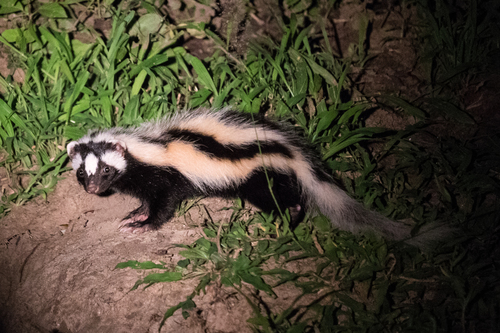
Zorilla
Ictonyx striatus
Meet Africa's answer to the skunk—the Zorilla. This bold, striped night-wanderer is a master hunter that brings high-contrast drama and expert pest control to any backyard it visits.
Quick Identification
Size
Head-body length: 30–38 cm (12–15 in); Tail: 17–28 cm (6.5–11 in); Weight: 0.6–1.3 kg (1.3–2.9 lbs)
Colors
High-contrast black body with four distinct white longitudinal stripes; white patches on the face and a predominantly white, bushy tail.
Key Features
- Four bold white stripes running down a black back
- White spot on the center of the forehead and above each eye
- Long, bushy white-tipped tail
- Low-slung, elongated weasel-like body
- Strong, curved claws for digging
When You’ll See Them
Behavior
The Zorilla, or striped polecat, is a solitary nocturnal predator known for its bold personality and striking appearance. While it resembles a skunk, it is actually a member of the mustelid family, making it a closer relative to weasels and honey badgers. It is a terrestrial animal that spends its waking hours snuffling through undergrowth and digging into the soil to find its next meal. When confronted by a predator, the Zorilla uses a dramatic defense mechanism: it arches its back, raises its long tail, and can discharge a foul-smelling secretion from its anal glands that is potent enough to deter even a lion.
In suburban or rural backyard settings, Zorillas are generally elusive and avoid direct human contact. However, they are highly beneficial to have around because they are exceptional at controlling pest populations. They are nomadic by nature, often moving between several different burrows or hollow logs within their home range rather than staying in one spot for too long. Socially, they are almost entirely solitary except during the brief mating season or when a mother is raising her kits.
EverydayEarth exclusive
Camera Tips
To capture high-quality footage of a Zorilla, camera placement is everything. These animals are low to the ground and have a habit of staying close to cover. Mount your camera no higher than 15 to 20 centimeters (6-8 inches) off the ground, aiming parallel to the earth. Look for natural funnels like gaps in fences, edges of stone walls, or well-worn paths through tall grass. Because their fur is so high-contrast, black-and-white infrared night vision can sometimes 'blow out' the white stripes; if your camera allows, adjust the IR intensity to a medium setting to ensure you don't lose the detail of their markings in a bright white blur.
Zorillas have an incredible sense of smell, which you can use to your advantage. A small amount of strong-smelling bait—such as canned sardines in oil or wet cat food—placed 2-3 meters in front of the camera is often enough to make them pause for a perfect 'hero shot.' Without bait, they tend to trot through the frame quite quickly with a fluid, undulating gait. Using a 'burst mode' or high-speed video setting is highly recommended to catch their movement, as they are surprisingly agile and rarely stay still for long.
If you are monitoring a backyard, focus your efforts on the transition zones. The areas where a manicured lawn meets a wilder hedge or a woodpile are prime hunting grounds for Zorillas searching for rodents. They are active year-round and do not hibernate, but you may find them more active on darker nights with less moonlight. During the rainy season, keep an eye out for them near termite mounds or freshly turned soil where they might be digging for larvae. Finally, always ensure your camera's trigger speed is set to its fastest possible interval to catch this 'striped lightning' before it disappears back into the shadows.
Similar Species
Species that look similar or are commonly confused with Zorilla.
Frequently Asked Questions
Record Zorilla at your habitat
Connect a camera to start building your own species record — AI identifies every visitor automatically.