Plan it
Board cut schedule
Every panel you'll need to cut, sized to actual milled lumber dimensions. Print this page or download the PDF to take into your workshop.
| Panel | Dimensions | Qty | Notes |
|---|---|---|---|
| Front | 5.5″ × 8″ | 1 | Drill 1.5" entrance hole 6" from the bottom, centered horizontally. |
| Back | 5.5″ × 14″ | 1 | Provides 3" mounting tabs at both the top and bottom. |
| Side (Fixed) | 5.5″ × 8″ | 1 | Angled top: 8" at back, 7" at front to shed water. |
| Side (Door) | 5.5″ × 7.75″ | 1 | Shortened by 1/4" to allow for easy swinging on hinges for cleaning. |
| Roof | 7.25″ × 9″ | 1 | Cut from 1x8 stock to create side eaves; mount with a 2" front overhang. |
| Floor | 4″ × 4″ | 1 | Ripped to 4" width to fit between 3/4" sides; clip corners for drainage. |
Source board layout
The main chassis (front, back, and sides) fits on a single 1x6. The floor must be ripped down to 4 inches wide to account for the thickness of the side walls. Using a 1x8 for the roof is critical as it protects the side-opening door from rain penetration.
Get materials
Shopping checklist
Check off items as you gather them — your progress is saved in your browser so you can come back to this page anytime.
Build it
Construction notes
- Wood: 3/4-inch (19 mm) untreated Western Red Cedar or Cypress for maximum weather resistance. Avoid plywood or pressure-treated lumber.
- Boards: One 1" x 6" x 6' and one 1" x 8" x 1' untreated cedar board will provide all necessary panels with room for errors.
- Hardware: 20x 1-5/8" galvanized deck screws, 2x 1-1/2" exterior brass hinges, 1x brass hook and eye, 2x 2-1/2" stainless steel mounting screws
- Ventilation: Leave a 1/4-inch gap between the top of the side panels and the roof to allow hot air to escape.
- Drainage: Clip 1/2-inch off each corner of the floor panel and drill four 1/4-inch holes to ensure the nest stays dry.
- Predator guard: Use a 24-inch stovepipe baffle mounted on a 4x4 post to deter climbing raccoons and snakes. Because wrens often nest near houses, ensure no overhanging branches allow squirrels to leap onto the roof.
Install it
Place it & time it right
Mount the box in a site with high structural complexity, such as near a brush pile, thicket, or under a porch eave. Unlike many birds, Carolina Wrens are comfortable nesting very close to human activity as long as there is dense cover nearby for a quick escape. Avoid open, windy fields and ensure the box is at least 30 feet away from other nesting pairs.
Seasonal timeline
When to install
Install by late January in the Southeast and early March in the Northeast to accommodate early-season pair bonding.
Nesting begins
In the Southeast, nesting can begin as early as March. In the Northeast and Midwest, pairs typically begin building in mid-to-late April. They are prolific breeders and may raise up to three broods in a single season if the climate is mild.
Eggs & incubation
3-7 eggs (usually 4-5) · 12-14 days
Fledging & cleaning
12-16 days after hatching · Remove old nesting material immediately after a brood fledges. Carolina Wrens prefer a clean box for subsequent broods, and this reduces parasite loads.
Regional considerations
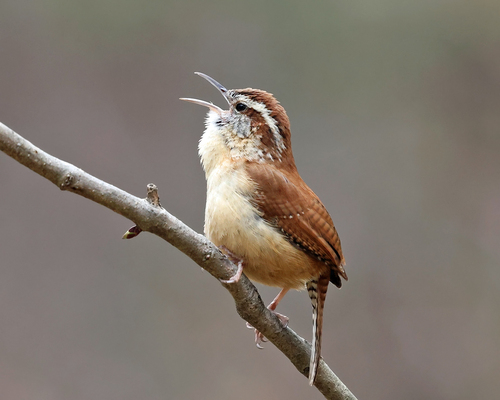
Carolina Wrens are found throughout the Eastern United States, from the Atlantic coast to the Great Plains, and as far north as Southern Ontario. They are permanent residents and do not migrate, though their northern range fluctuates based on winter severity.
In the deep South, breeding begins in early spring and can continue into August. In northern latitudes or higher elevations, the season is shorter, typically concluding by July to allow the birds to store fat for the winter.
Raccoons and rat snakes are the primary threats. A proper baffle is essential, and keeping the entrance hole exactly 1.5 inches prevents larger competitors like Starlings from entering.
Add a camera
Watch it happen
Carolina Wrens build 'domed' nests with a side entrance, which can make interior viewing a challenge. For the best results, mount a small, wide-angle USB or Wi-Fi 'cube' camera in the top rear corner of the box, angled toward the entrance hole. This allows you to see the parents entering the dome and feeding the chicks.
Because these wrens are highly active during the day, ensure your camera has a high frame rate to capture their quick movements. Since the interior of a wren box is quite dark, a camera with invisible 940nm IR (Infrared) LEDs is essential to see inside the nest without disturbing the birds' circadian rhythms.
Exterior monitoring is also highly rewarding for this species. A battery-powered smart camera (like a Blink or Arlo) mounted on a nearby post or wall about 4 feet away will capture their frequent 'teakettle' singing and the energetic 'changing of the guard' during incubation.
Route all cables through a small notch in the back panel or the ventilation gap. For an all-in-one DIY solution, a small 2MP or 4MP USB camera module mounted to the ceiling is the gold standard for high-definition streaming on EverydayEarth platforms.
Off-grid power with a USB solar panel
Nest boxes are almost always far from a power outlet. A 5V USB solar panel with a built-in battery is the cleanest solution — it powers most interior USB cameras, Blink cameras (via their USB port), and many trail cameras indefinitely.
- Panel position: Mount on the same post as the box, 1–2 ft above, angled 30–45° from vertical and facing south.
- Cable routing: Run inside split loom or 1/2″ conduit so squirrels can't chew it. Enter through the same grommeted hole as the camera cable.
- Battery buffer: Pick a panel with a 5–10 Ah battery so the camera runs through cloudy days and overnight for nocturnal species.
- Weatherproofing: Wrap every cable connection in self-amalgamating rubber tape.
Troubleshoot
Common problems & solutions
House Wren competition
House wrens may fill the box with sticks to 'claim' it. Remove unlined stick nests early in the season before eggs are laid.
Box remains empty
Move the box closer to thick cover or a brush pile. Carolina Wrens dislike crossing open spaces to reach their nest.
Wet nesting material
Check the roof overhang and ensure the side door is tightly latched. Ensure drainage holes are not clogged with debris.
Blowfly larvae
If you notice lethargic chicks, check for parasites. Clean the box thoroughly between each of the three potential annual broods.
Common questions
Frequently asked questions
A 1.5-inch (38 mm) entrance hole is the perfect size for Carolina Wrens. It is large enough for their stocky bodies but small enough to exclude larger predators and competitors like European Starlings.
Mount the box between 5 and 10 feet high. They are lower-level foragers and prefer being relatively close to the shrub layer, but high enough to be safe from ground predators.
Put the box up by late winter (January or February). Since Carolina Wrens are non-migratory, they often use nest boxes as roosting sites during cold winter nights before the breeding season begins.
Face the box East or Northeast. This protects the entrance from prevailing westerly winds and prevents the box from overheating during the hot afternoon sun.
While the 1.5-inch hole fits both, placing the box near dense thickets rather than in the open helps, as House Sparrows prefer open areas. Monitor the box and remove any grass-and-trash nests built by sparrows.
Carolina Wrens are prolific and can raise up to three broods in a single season, particularly in the Southern United States where the weather remains warm longer.
Clean the box immediately after every brood fledges. They will often start a second nest within days, and removing the old material prevents the buildup of mites and blowflies.
Take it with you
Download free PDF plans
Get a printable PDF with materials list, dimensions, assembly notes, and a QR code back to this page. We'll send occasional updates on new plans and habitat tips — unsubscribe anytime.
Prefer not to share your email? View materials online — everything is free and visible on this page.