Plan it
Board cut schedule
Every panel you'll need to cut, sized to actual milled lumber dimensions. Print this page or download the PDF to take into your workshop.
| Panel | Dimensions | Qty | Notes |
|---|---|---|---|
| Front | 9.25″ × 28″ | 1 | Drill 4" diameter hole 20" from the bottom; score the interior surface with a saw to create a 'ladder' for fledglings. |
| Back | 9.25″ × 34″ | 1 | Provides 3" mounting tabs at top and bottom; pre-drill for lag bolts. |
| Side (Fixed) | 9.25″ × 28″ | 1 | Angled at 10 degrees at the top to shed water. |
| Side (Door) | 9.25″ × 27.75″ | 1 | Shortened slightly for clearance; attach with hinges at the top for easy cleaning. |
| Roof | 11.25″ × 14″ | 1 | Use a 1x12 board to ensure a 2" overhang on all sides; slope 10 degrees forward. |
| Floor | 7.75″ × 7.75″ | 1 | Recess 1/2" up from the bottom of sides; trim corners for drainage. |
Source board layout
All primary panels are cut from 1x10 stock (9.25" actual width). Because of the height, two 8-foot boards are required. The roof is wider (1x12) to provide a drip edge that protects the side-opening door and the entrance hole from rain.
Get materials
Shopping checklist
Check off items as you gather them — your progress is saved in your browser so you can come back to this page anytime.
Build it
Construction notes
- Wood: 1-inch (25 mm) or 3/4-inch (19 mm) untreated cedar or cypress. Do not use pressure-treated wood or plywood.
- Boards: Two 1" x 10" x 8' untreated cedar boards and a 14" scrap of 1x12 for the roof.
- Hardware: 30x 2" stainless steel deck screws, 2x 2-1/2" exterior zinc-plated hinges, 1x heavy-duty brass gate latch, 4x 4" galvanized lag bolts with washers for tree mounting, 4 inches of kiln-dried cedar shavings
- Ventilation: Gap the side panels 1/4" below the roof line and drill two 1/2" holes near the top of each side panel for cross-ventilation.
- Drainage: Drill four 1/2" holes in the floor panel and clip all four corners by 1/2" to ensure the deep cavity stays dry.
- Predator guard: Install a 30-inch wide metal flashing wrap or a commercial stovepipe baffle on the tree trunk below the box to deter climbing raccoons and snakes. Ensure the metal is smooth and securely fastened.
Install it
Place it & time it right
Mount the box on a large-diameter, sturdy tree within a mature woodland or near a forest edge. Ensure there is a clear flight path to the entrance and avoid placing it near bird feeders to reduce stress and competition from other species.
Seasonal timeline
When to install
Early winter (December to January) to allow the box to weather and to ensure it is available before early spring territory establishment.
Nesting begins
In the Southeast, nesting begins as early as March. In the Northeast and Midwest, expect activity in late April to May, while Pacific Northwest populations typically begin in mid-May.
Eggs & incubation
3-5 eggs (usually 4) · 15-18 days
Fledging & cleaning
24-31 days after hatching · Clean the box in late autumn after all nesting activity has ceased. Remove old nesting material and debris, then replace the bottom 4 inches with fresh cedar shavings.
Regional considerations
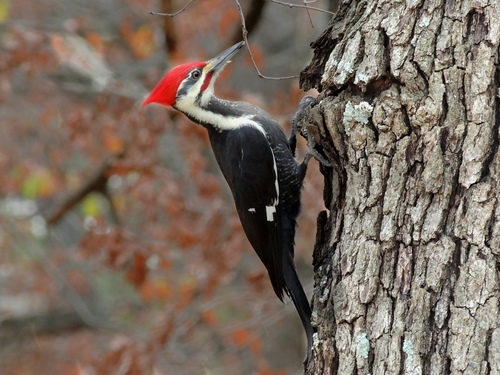
The Pileated Woodpecker is found throughout the eastern half of North America, the Great Lakes region, across the boreal forests of Canada, and down the Pacific Coast. They require mature forests with large-diameter trees for natural nesting.
Nesting occurs earlier in southern latitudes where spring arrives in February. In high-elevation mountain ranges or northern Canadian forests, breeding may be delayed by several weeks due to lingering snow and late insect emergence.
Raccoons and larger climbing snakes are the primary threats to eggs and nestlings. The heavy-duty 1-inch thick cedar walls and a properly installed trunk baffle are the best defenses against these predators.
Add a camera
Watch it happen
Given the exceptional depth of a Pileated Woodpecker box (up to 24 inches), an interior camera must be mounted at the very top, angled sharply downward to capture the floor where eggs are laid. Because these woodpeckers are sensitive to light and deep cavities are naturally dark, high-quality infrared (IR) night vision is essential for clear footage without disturbing the birds with white light.
A wide-angle lens is preferred to capture both the adults entering the hole and the activity at the bottom of the cavity. Because of the box's size, you have more room for a small USB-powered interior camera or a specialized bird box cam, but ensure all cables are stapled securely to the corners to prevent the birds from snagging them while excavating.
For exterior monitoring, a trail camera or a Blink-style outdoor camera should be mounted on a neighboring tree 8-10 feet away. This provides a spectacular view of the adult's arrival and the fledglings peering out of the 4-inch entrance hole during their final days before flight.
We recommend a hardwired interior POE (Power over Ethernet) camera for this species, as the height and remote forest placement of these boxes make frequent battery changes difficult and disruptive.
Off-grid power with a USB solar panel
Nest boxes are almost always far from a power outlet. A 5V USB solar panel with a built-in battery is the cleanest solution — it powers most interior USB cameras, Blink cameras (via their USB port), and many trail cameras indefinitely.
- Panel position: Mount on the same post as the box, 1–2 ft above, angled 30–45° from vertical and facing south.
- Cable routing: Run inside split loom or 1/2″ conduit so squirrels can't chew it. Enter through the same grommeted hole as the camera cable.
- Battery buffer: Pick a panel with a 5–10 Ah battery so the camera runs through cloudy days and overnight for nocturnal species.
- Weatherproofing: Wrap every cable connection in self-amalgamating rubber tape.
Troubleshoot
Common problems & solutions
European Starling competition
Starlings are the main competitor; monitor the box frequently and remove starling nests immediately. Pileateds are large enough to defend the box, but starlings are persistent.
Birds ignore the box
Ensure the box is packed with 4-5 inches of wood shavings. Pileateds have a biological drive to 'excavate' their home; they rarely use a completely empty box.
Box is too heavy to mount
Use a pulley system or a 'hoist and bolt' method. This box can weigh 25+ lbs; always use lag bolts rather than nails for safety.
Bees or wasps in the cavity
Apply a thin layer of unscented bar soap to the interior ceiling to prevent comb attachment without harming the birds.
Common questions
Frequently asked questions
A Pileated Woodpecker requires a 4-inch (102 mm) diameter round hole, or a 3x4 inch vertical oval. This size accommodates their large frame while helping to exclude larger predators.
Mount the box between 15 and 30 feet high. They prefer higher elevations in mature trees to feel secure from ground-level predators and to have a clear flight path.
Ideally, install the box by January. This allows the birds to investigate the site during the winter as they establish territories for the spring breeding season.
Face the box East or Southeast. This provides warmth from the morning sun while protecting the large entrance from the cooling effects of prevailing winds and heavy rain.
While difficult to prevent entirely, placing the box deep in mature woods rather than near open fields or suburban lawns can reduce starling interest. Regular monitoring is key.
They typically raise only one brood per year. The long period of incubation and nestling care (nearly two months total) makes a second brood biologically difficult.
Clean the box in the late fall. Woodpeckers don't reuse old nesting material and appreciate a fresh 4-inch layer of cedar shavings to 're-excavate' the following spring.
Take it with you
Download free PDF plans
Get a printable PDF with materials list, dimensions, assembly notes, and a QR code back to this page. We'll send occasional updates on new plans and habitat tips — unsubscribe anytime.
Prefer not to share your email? View materials online — everything is free and visible on this page.