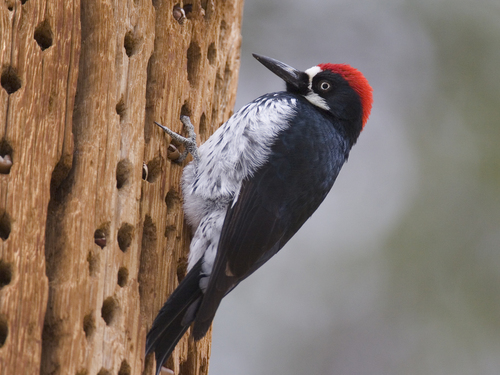
Acorn Woodpecker
Melanerpes formicivorus
The social architect of the oak woods, Acorn Woodpeckers are famous for building massive 'pantry' trees and living in tight-knit family groups. Their striking clown-like faces and constant activity make them one of the most entertaining birds to watch on a backyard camera.
Quick Identification
Size
Length 19–23 cm (7.5–9 in); Wingspan 35–43 cm (13.8–16.9 in); Weight 65–90 g (2.3–3.2 oz)
Colors
Glossy black back and wings with a white rump and belly. Distinctive 'clown face' with a white forehead and yellowish throat. Males have a full red cap; females have a black band between the white forehead and red crown.
Key Features
- Pale white iris giving an intense 'staring' look
- Red crown patch
- White wing patches prominent in flight
- Distinctive white forehead and yellowish throat
When You’ll See Them
Sightings on EverydayEarth
Jun 25, 2026
An Acorn Woodpecker clings to the side of the wooden feeder post, scanning its surroundings, while a White-winged Dove stands on the lower feeding platform. The scene is set against a lush backdrop of desert vegetation in the afternoon light.
Jun 19, 2026
A high-activity scene at the sanctuary's feeding area. Multiple White-winged Doves are perched on the crossbeam and landing at the feeder, while several smaller Inca Doves feed on the ground-level tray. An Acorn Woodpecker stays perched on the far left of the horizontal log, and a male House Finch is seen in the upper-left foliage.
Jun 18, 2026
An Acorn Woodpecker is perched vertically on a suet cage, actively pecking at the contents. It pauses several times to look around its surroundings before returning to feed.
Jun 16, 2026
An Acorn Woodpecker flies into the frame from the left and lands on the lower arm of the rustic wooden feeder. It hops onto the main post and then up to the top crossbar, investigating the perches for food.
Jun 15, 2026
A busy scene at the bird sanctuary features several species interacting with the feeding station. An Acorn Woodpecker and a Bridled Titmouse are actively foraging on the wooden structure and suet block. A Bronzed Cowbird perches on a branch to the left, while a Mourning Dove briefly lands on the upper beam before taking flight again.
Jun 13, 2026
An Acorn Woodpecker visits a large tree cavity used as a condor nest. It hops across the wood chips and debris on the nest floor, searching the interior before flying away.
Geographic range
Where Does the Acorn Woodpecker Live?
The Acorn Woodpecker is a hallmark species of the Western Americas, native to the oak-rich landscapes of the coastal and interior mountains. Its range begins in Oregon and California, stretching through the American Southwest into Mexico. This core population extends through the highlands of Central America and reaches as far south as the northern Andes in Colombia, wherever suitable oak forests provide their essential food source.
Basemap © OpenStreetMap contributors
Behavior
Acorn Woodpeckers are highly social, living in complex family groups of up to 15 individuals. They are best known for their cooperative breeding and their incredible 'granaries'—dead trees, utility poles, or even wooden houses where they drill thousands of small holes to store individual acorns. The entire group works together to collect, store, and defend these massive food caches against squirrels and other birds.
Unlike many solitary woodpecker species, Acorn Woodpeckers spend a significant amount of time in the open. They are frequently seen 'flycatching,' jumping from high perches to snag insects in mid-air. Their social nature makes them very vocal, and they often communicate with a raucous, laughing 'waka-waka' call that can be heard throughout oak woodlands and suburban parks.
EverydayEarth exclusive
Camera Tips
To capture the social dynamics of Acorn Woodpeckers, identify a 'granary' tree—these are impossible to miss once you see the thousands of small holes drilled into the bark. Mount your camera 5 to 8 feet high on a neighboring branch or a fence post facing the granary. Because these birds are communal, you are likely to capture multiple individuals interacting, so use a wider field of view rather than a tight zoom.
If you don't have a granary nearby, focus on a high-quality suet feeder or a birdbath. Acorn Woodpeckers are very active around water, especially in drier climates like California and Arizona. Place the camera about 4 feet away from the water source and use a high-speed trigger setting to catch the action. These birds are bold and quickly acclimate to the presence of a camera, so you won't need much camouflage.
The best time for dramatic footage is during the autumn acorn harvest. Set your camera to video mode with a high frame rate (60fps or higher) to capture the precise, rapid-fire movement of the birds wedging acorns into holes. Pay attention to the lighting; their high-contrast black and white feathers can lead to overexposed shots in harsh midday sun, so early morning or late afternoon light is ideal for showcasing the iridescent sheen of their plumage.
Similar Species
Species that look similar or are commonly confused with Acorn Woodpecker.
Frequently Asked Questions
Record Acorn Woodpecker at your habitat
Connect a camera to start building your own species record — AI identifies every visitor automatically.