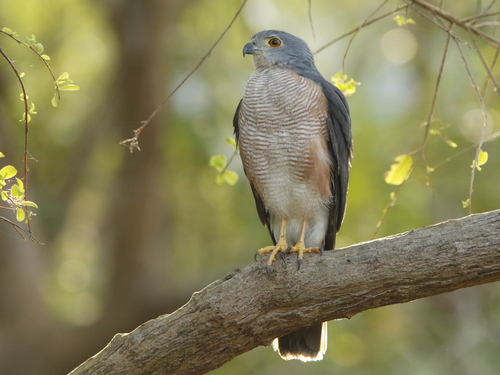
African Goshawk
Aerospiza tachiro
The silent ghost of the African canopy, this agile raptor has turned leafy suburbs into its personal hunting ground. Listen for its morning 'click' and watch the shadows for a flash of barred wings.
Quick Identification
Size
Length: 35–45 cm (14–18 in); Wingspan: 70–90 cm (28–35 in); Weight: 150–510 g (0.3–1.1 lbs)
Colors
Slate-grey to dark-brown upperparts; white underparts with fine rufous or grey barring; bright yellow eyes and legs; greyish-black beak with yellow cere.
Key Features
- Bright yellow iris and cere
- Broad, rounded wings for forest flight
- Long tail with 3-4 dark horizontal bars
- Heavily barred underparts, often with a rufous wash
When You’ll See Them
Geographic range
Where Does the African Goshawk Live?
The African Goshawk is native to sub-Saharan Africa, maintaining a massive range across the central, eastern, and southern parts of the continent. From the lush forests of Ethiopia and the Great Lakes region down through the coastal woodlands of Mozambique and the garden suburbs of South Africa, this species is a permanent resident wherever there is sufficient tree cover. While they avoid true deserts, they are incredibly adaptable and can be found in almost any wooded habitat from sea level to high-altitude montane forests.
Basemap © OpenStreetMap contributors
Behavior
The African Goshawk is a master of stealth, often remaining perched silently within dense foliage for long periods. Despite their secretive nature, they are most famous for their rhythmic, high-pitched vocalizations delivered during early morning display flights. The male typically circles high above the canopy at sunrise, emitting a characteristic 'whit-whit-whit' call that can be heard from a significant distance, even when the bird is a mere speck in the sky.
These raptors are highly territorial and generally solitary outside of the breeding season. In suburban environments, they have become remarkably bold, often utilizing large garden trees as lookout points to hunt smaller birds at garden feeders. While they are fierce predators, they are not naturally aggressive toward humans, though they will vigorously defend their nest sites from perceived threats.
EverydayEarth exclusive
Camera Tips
To capture the African Goshawk on your backyard camera, focus on water and height. These hawks are frequent bathers, especially in the heat of the afternoon. Position your camera approximately 5 to 10 feet away from an elevated, sturdy bird bath. Unlike smaller songbirds, African Goshawks need a larger landing platform, so a wide, shallow basin mounted on a pedestal is ideal. Ensure the camera is angled slightly downward to capture the full wing-spread during their vigorous bathing sessions.
Timing is everything with this species. If you hear their 'whit-whit' call in the early morning, they are likely active in your immediate area. Set your camera to 'Burst Mode' or 'High-Speed Video' with a fast trigger speed (0.2s or less). Because they move with explosive speed when hunting or departing a perch, a standard single-shot setting will often result in a 'motion-blur' or an empty frame of just a tail disappearing.
For trail camera enthusiasts in more rural areas, look for 'plucking posts'—flat-topped stumps or horizontal branches littered with feathers. Goshawks return to these specific spots to process their prey. Mounting a camera 3-4 feet high facing one of these posts can provide incredible footage of their feeding behavior. Avoid using meat baits in suburban areas, as this can attract unwanted scavengers; instead, focus on providing a reliable water source and maintaining thick vegetation that attracts the smaller birds they naturally hunt.
Similar Species
Species that look similar or are commonly confused with African Goshawk.
Frequently Asked Questions
Record African Goshawk at your habitat
Connect a camera to start building your own species record — AI identifies every visitor automatically.