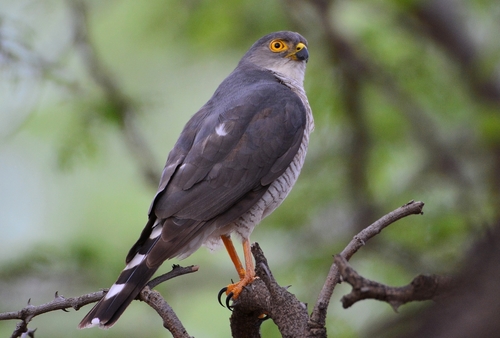
Little Sparrowhawk
Tachyspiza minulla
Africa's smallest raptor is a masterpiece of evolution, combining lightning speed with tactical brilliance. Often hiding in plain sight within suburban gardens, the Little Sparrowhawk is the ultimate backyard ghost.
Quick Identification
Size
Length: 20-25 cm (8-10 in); Wingspan: 39-52 cm (15-20 in); Weight: 74-150g (2.6-5.3 oz)
Colors
Slate-grey to dark-grey upperparts with white underparts featuring fine rufous barring; juveniles are browner with coarser spotting.
Key Features
- Two distinct white spots on the central upper tail feathers
- Bright yellow-orange eyes and long yellow legs
- Tiny size, roughly equivalent to a large thrush or dove
- Short, rounded wings and a relatively long tail for maneuvering through brush
When You’ll See Them
Geographic range
Where Does the Little Sparrowhawk Live?
Native to the African continent, the Little Sparrowhawk is widely distributed across Sub-Saharan Africa. Its core range extends from the highlands of Ethiopia and South Sudan, sweeping southwards through East African countries like Kenya and Tanzania, and reaching down into the lush eastern and southern regions of South Africa. While it is absent from the driest desert regions and the deepest primary rainforests, it has adapted remarkably well to human-modified landscapes across Zimbabwe, Zambia, and Mozambique.
Basemap © OpenStreetMap contributors
Behavior
The Little Sparrowhawk is a master of the ambush. Unlike larger raptors that soar high in the sky to find prey, this diminutive hunter spends much of its time perched silently within dense foliage. It is remarkably secretive, often only noticed when it breaks cover in a sudden, blurred dash to snatch a small bird or insect. Despite its small stature, it is incredibly bold and will frequently hunt in suburban gardens, using hedgerows and garden fences as tactical cover.
In a social context, these birds are usually seen alone or in pairs. During the breeding season, they become more vocal, performing undulating flight displays over their territory. They are highly territorial and will vigorously defend their nesting site—typically a small platform of sticks hidden high in a tree canopy—against much larger intruders.
EverydayEarth exclusive
Camera Tips
To capture a Little Sparrowhawk on your backyard camera, focus your efforts on water sources. Because they are high-metabolism hunters, they drink and bathe frequently. Position your camera about 2 to 3 feet off the ground, angled slightly downward toward a birdbath or a shallow pond. These hawks are incredibly fast, so use a camera with a high trigger speed (0.2 seconds or less) and set it to 'burst mode' to catch the action as they splash or dive in.
Placement is everything. Don't put your camera in the wide open; instead, place it near the edge of dense shrubbery or 'screening' trees like Acacias or Eugenias. The Little Sparrowhawk uses these as staging posts. If you have a bird feeder that attracts small waxbills or mannikins, place a second camera 5-10 feet away facing a nearby branch. The hawk will often sit there for several minutes, scanning the feeder, providing the perfect opportunity for a still portrait.
Lighting can be tricky in wooded areas. Try to position the camera so the sun is behind it, especially during the early morning hours when these birds are most active. If your camera allows for sensitivity adjustments, set the PIR (passive infrared) sensor to high. Since these birds are small and move rapidly, a low-sensitivity setting might miss the 'blur' of their arrival at a water station.
Seasonal timing is also key. While they are year-round residents, you are most likely to get high-quality footage during the drier months when natural water sources are scarce and they are forced to visit garden birdbaths. During the breeding season (usually August to January in Southern Africa), look for them carrying small sticks or prey items, and try to identify the tall, leafy trees they might be using for nesting.
Similar Species
Species that look similar or are commonly confused with Little Sparrowhawk.
Shikra
Slightly larger with a paler grey back and lacks the two white spots on the central tail feathers.
Gabar Goshawk
Has a conspicuous white rump visible in flight and lacks the specific white tail-feather spots of the Little Sparrowhawk.
African Goshawk
Significantly larger with much heavier barring on the underparts and a different, louder 'whit-whit' call.
Frequently Asked Questions
Record Little Sparrowhawk at your habitat
Connect a camera to start building your own species record — AI identifies every visitor automatically.