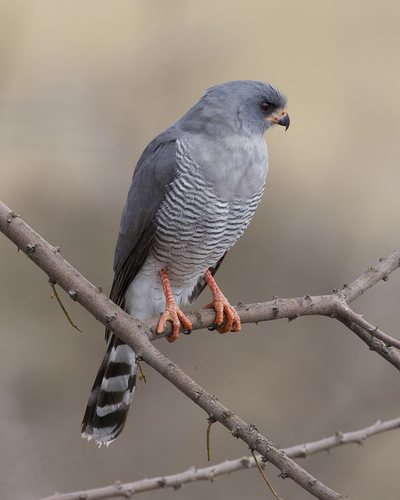
Gabar Goshawk
Micronisus gabar
A pint-sized powerhouse of the African savanna, the Gabar Goshawk is a master of the high-speed ambush. With its striking red legs and piercing gaze, this adaptable raptor is as comfortable in a wild woodland as it is in a suburban backyard.
Quick Identification
Size
Length: 28–36 cm (11–14 in); Wingspan: 58–66 cm (23–26 in); Weight: 110–220g (3.9–7.8 oz)
Colors
Two morphs exist: the pale morph has grey upperparts, a white rump, and a finely barred grey-and-white belly. The melanistic morph is almost entirely black. Both morphs feature bright red legs and a red cere (beak base).
Key Features
- Distinctive white rump visible during flight in pale morphs
- Starkly red legs and cere (beak base)
- Long, slender tail with dark barring
- Short, rounded wings for rapid maneuvering
When You’ll See Them
Geographic range
Where Does the Gabar Goshawk Live?
Native to the African continent and the southwestern Arabian Peninsula, the Gabar Goshawk is a widespread resident of Sub-Saharan Africa. Its range spans from the southern reaches of the Sahara down to South Africa, excluding only the densest tropical rainforests and the most extreme desert regions. In the Middle East, it is commonly found in the rugged landscapes of Yemen and Saudi Arabia, thriving wherever there is sufficient tree cover for nesting and hunting.
Basemap © OpenStreetMap contributors
Behavior
The Gabar Goshawk is a high-energy pursuit predator known for its exceptional agility and speed. Unlike many larger raptors that soar to hunt, the Gabar often waits in ambush within the canopy, launching explosive attacks on unsuspecting prey. It is a bold bird that is not easily deterred by the presence of humans, often nesting in suburban trees and hunting in backyards where bird feeders are present.
Socially, they are usually seen alone or in breeding pairs. They are highly territorial during the nesting season, often building small stick nests in the forks of thorny acacia trees. A unique aspect of their behavior is their frequent association with social spiders; they often incorporate spider webs into their nests, which may help with camouflage or structural integrity.
EverydayEarth exclusive
Camera Tips
To capture the Gabar Goshawk on your backyard camera, the most effective strategy is to target their watering needs. These raptors are frequent visitors to bird baths, especially in drier climates. Position your camera 5 to 10 feet away from a water source, angled slightly upward to catch them as they land on the edge. Because they are incredibly fast, ensure your camera's shutter speed or trigger speed is at its fastest setting—aim for a trigger speed of 0.2 seconds or less to avoid capturing just a blur of feathers.
Placement height is critical if you are monitoring a nesting area or a favorite perch. Look for tall, thorny trees like Acacias; Gabar Goshawks prefer to perch on high, unobstructed branches to scan for prey. Mount your camera at a height of 6 to 10 feet on an adjacent tree or a tall post. If you are in a suburban setting, they are often attracted to areas where smaller birds congregate, such as near seed feeders, using the nearby vegetation as cover for an ambush.
Regarding settings, utilize a high-frame-rate video mode or a multi-shot burst mode. The Gabar's movements are erratic and lightning-quick; a single photo often misses the action. If your camera allows for "Pre-roll" or "Hybrid" mode (taking a short video before the photo), enable it. In early morning or late afternoon light, the red legs and cere of the goshawk will pop against their grey feathers, so try to position your camera with the sun behind it to illuminate these identifying features.
Seasonal timing is less of a factor since they are resident birds, but you will see increased activity during the breeding season when they are constantly hunting to feed chicks. During this time, look for 'plucking posts'—stumps or flat branches where they take their prey to remove feathers. Placing a camera near one of these spots provides a high probability of capturing clear, stationary footage of the bird during a meal.
Similar Species
Species that look similar or are commonly confused with Gabar Goshawk.
Shikra
The Shikra lacks the Gabar's white rump and has shorter, orange-yellow legs instead of the Gabar's long red legs.
Dark Chanting Goshawk
Significantly larger than the Gabar, with a more upright posture and orange (not red) legs and cere.
Little Sparrowhawk
Smaller with a white-spotted tail and yellow eyes, whereas the Gabar has dark eyes and a barred tail.
Frequently Asked Questions
Record Gabar Goshawk at your habitat
Connect a camera to start building your own species record — AI identifies every visitor automatically.