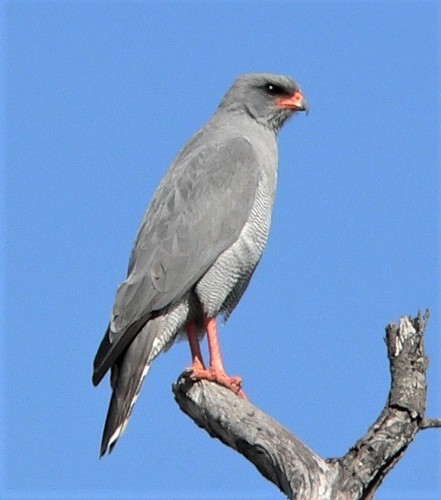
Dark Chanting-Goshawk
Melierax metabates
With its striking orange legs and a melodic, flute-like song that carries across the savannah, the Dark Chanting-Goshawk is one of Africa's most charismatic raptors. A master of the perch, this elegant hunter is a frequent sight for those exploring the open woodlands and bushy plains.
Quick Identification
Size
Length: 38–51 cm (15–20 in); Wingspan: 95–110 cm (37–43 in); Weight: 500–850 g (1.1–1.9 lbs)
Colors
Slate-gray head and upperparts, finely barred gray-and-white underparts, with bright orange-red cere and legs.
Key Features
- Bright orange-red legs and base of beak (cere)
- Finely barred gray-and-white belly
- Broad, rounded wings with black primaries
- Dark gray upperparts with a white-barred tail
When You’ll See Them
Geographic range
Where Does the Dark Chanting-Goshawk Live?
This bird of prey is primarily native to the vast landscapes of sub-Saharan Africa, ranging from Senegal in the west across to Ethiopia and Somalia in the east, and extending south into northern South Africa. It also maintains a presence in the southwestern Arabian Peninsula, specifically within Yemen and Saudi Arabia. While widespread across the African savannah, a small, isolated, and vulnerable population still exists in the Souss Valley of southern Morocco, marking the northernmost limit of its range.
Basemap © OpenStreetMap contributors
Behavior
The Dark Chanting-Goshawk is a bold and conspicuous raptor, frequently seen perched atop high vantage points such as acacia trees, utility poles, or termite mounds. Unlike many elusive birds of prey, this species is relatively comfortable around human activity, often utilizing roadside infrastructure to scan for prey. They are primarily "perch-hunters," spending hours motionless while monitoring the ground for movement before launching into a swift, descending strike.
The species earns its name from its distinctive vocalizations during the breeding season. Males perform a series of melodic, piping whistles and tuneful "chants" from their perches to establish territory and attract mates. They are generally solitary or found in monogamous pairs. Interestingly, they are known to be opportunistic followers, sometimes trailing honey badgers or ground hornbills to snatch up small animals flushed out by these larger foragers.
EverydayEarth exclusive
Camera Tips
To capture the Dark Chanting-Goshawk on an AI-powered camera, placement is everything. These birds are "sentinel" hunters that prefer the highest available point in an open area. If you have a property with scattered trees, mount your camera 6 to 10 feet up on a sturdy, isolated post or a prominent tree limb that overlooks a clearing. Because they have exceptional eyesight, they will often return to the same successful hunting perch daily, making these "hotspots" the best location for consistent captures.
Since these are diurnal birds, prioritize your camera’s daytime settings. Use a high shutter speed if your device allows it; while the goshawk spends a lot of time sitting still, its take-off and strike are lightning-fast. A "Photo + Video" trigger mode is highly recommended. The bird’s behavior—such as its rhythmic "chanting" or the way it bobbles its head to gain depth perception—is best captured in video format, providing much more character than a simple still image.
While you shouldn't bait raptors with meat (which can attract unwanted scavengers or habituate the bird), you can attract them naturally by managing the environment. A well-placed birdbath or a shallow, elevated water feature can be a major draw in more arid regions. Ensure the camera is positioned to avoid direct lens flare from the morning sun, as the backlighting can wash out the subtle gray barring on the bird's chest and the vibrant orange of its legs.
Similar Species
Species that look similar or are commonly confused with Dark Chanting-Goshawk.
Pale Chanting-Goshawk
Lighter gray overall with a conspicuous white rump, whereas the Dark species has a dark rump.
Eastern Chanting-Goshawk
Very similar but found in East Africa; it typically has a slightly paler iris and different barring patterns on the wing.
Gabar Goshawk
Much smaller in size with a more prominent white rump and different tail banding.
Frequently Asked Questions
Record Dark Chanting-Goshawk at your habitat
Connect a camera to start building your own species record — AI identifies every visitor automatically.