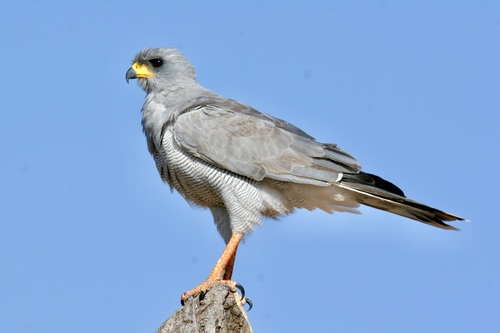
Eastern Chanting-Goshawk
Melierax poliopterus
With its striking orange legs and melodic morning whistle, the Eastern Chanting-Goshawk is the elegant sentinel of the East African savanna. This medium-sized raptor is as comfortable sprinting across the ground as it is soaring through the thermal winds.
Quick Identification
Size
Length: 45–55 cm (18–22 in); Wingspan: 96–110 cm (38–43 in); Weight: 500–850 g (1.1–1.9 lbs)
Colors
Pale slate-grey head and upperparts; white belly with fine grey horizontal barring; bright orange-red legs and cere; white rump visible in flight.
Key Features
- Vibrant orange-red cere and long, spindly legs
- Pure white rump patch that contrasts with grey back in flight
- Fine grey-and-white 'vermiculated' barring on the underparts
- Distinctive melodic whistling call used during breeding season
When You’ll See Them
Geographic range
Where Does the Eastern Chanting-Goshawk Live?
The Eastern Chanting-Goshawk is native to the diverse landscapes of East Africa, where it is a common sight across the Horn of Africa and the Rift Valley. Its core range encompasses the arid bushlands of Ethiopia, Somalia, Kenya, and northern Tanzania, reaching into parts of eastern Uganda and South Sudan. Thriving in dry environments, this species is a resident throughout the year across these regions, rarely wandering far from its established territory.
Basemap © OpenStreetMap contributors
Behavior
The Eastern Chanting-Goshawk is a conspicuous and elegant raptor, often seen perched stoically atop acacia trees, telephone poles, or termite mounds. Unlike many other hawks that hunt almost exclusively from the air, this species is quite comfortable on the ground. It is known to stalk prey on foot, using its long legs to stride through the grass in pursuit of lizards or large insects, occasionally running with surprising speed.
These birds are primarily solitary or found in pairs. During the breeding season, they live up to their name with a series of tuneful, whistling calls—often described as a 'chant'—delivered from a high perch to defend their territory or attract a mate. While they are bold hunters, they are generally wary of close human approach but have adapted well to living alongside rural communities and roadside habitats.
EverydayEarth exclusive
Camera Tips
To capture the Eastern Chanting-Goshawk on camera, focus your efforts on prominent vertical structures. These birds love 'vantage point' perching. If you have a tall, dead tree or a sturdy fence post on your property, mount your camera facing the perch with the sun at your back. A side-angle view is often better than a direct frontal shot to capture the profile of their distinctive hooked beak and long legs.
Because they are highly terrestrial hunters, placing a trail camera near a water source like a low-profile bird bath or a livestock trough in dry areas is incredibly effective. They frequently visit water holes during the heat of the day to drink and bathe. Set your camera to 'Burst Mode' or high-speed video, as their movements when dropping from a perch or splashing in water are lightning-fast.
In terms of settings, use a high shutter speed if your camera allows it to avoid motion blur during flight. If you are setting up in an open savanna area, ensure your camera is well-camouflaged; while they aren't as shy as some forest hawks, they have keen eyesight and may avoid a site if they notice a large, plastic box appearing overnight. Morning light provides the best opportunity to capture the subtle grey textures of their plumage and the vivid orange of their legs.
Similar Species
Species that look similar or are commonly confused with Eastern Chanting-Goshawk.
Dark Chanting-Goshawk
Has a barred (not pure white) rump and a much darker charcoal-grey plumage on the head and chest.
Pale Chanting-Goshawk
Found primarily in Southern Africa; very similar but lacks the distinct white rump of the Eastern species.
Gabar Goshawk
Much smaller in size with a different barring pattern and lacks the extremely long legs of the Melierax genus.
Frequently Asked Questions
Record Eastern Chanting-Goshawk at your habitat
Connect a camera to start building your own species record — AI identifies every visitor automatically.