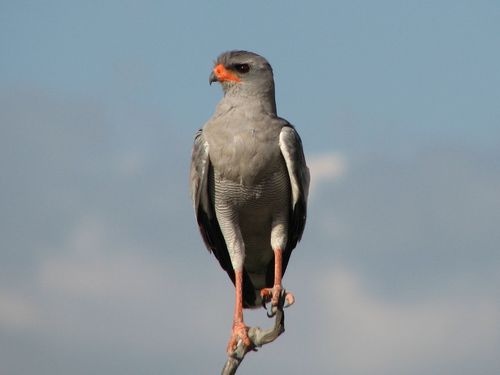
Pale Chanting-Goshawk
Melierax canorus
The Pale Chanting-Goshawk is the silver sentinel of the African desert, easily spotted by its vibrant red legs and melodic song. A master of both the sky and the sand, it is one of the few hawks you'll find as comfortable running on the ground as it is soaring in the thermal winds.
Quick Identification
Size
Length: 46–63 cm (18–25 in); Wingspan: 102–123 cm (40–48 in); Weight: 400–1000 g (0.9–2.2 lbs)
Colors
Pale silver-grey upperparts, white underparts with fine charcoal-grey horizontal barring, and distinct orange-red legs and cere.
Key Features
- Bright orange-red legs and cere (nose base)
- Broad white rump patch highly visible in flight
- Finely barred grey-and-white belly plumage
- Long, yellow-to-orange legs adapted for walking
When You’ll See Them
Geographic range
Where Does the Pale Chanting-Goshawk Live?
Native to the southern reaches of the African continent, the Pale Chanting-Goshawk is a specialist of arid environments. Its core population is found across Namibia, Botswana, and the western half of South Africa, extending north into southern Angola and parts of Zimbabwe. While it is a common sight in the dry Karoo and Kalahari basins, it avoids the lush, high-rainfall forests of the east and the extreme coastal fynbos.
Basemap © OpenStreetMap contributors
Behavior
The Pale Chanting-Goshawk is a conspicuous and often bold raptor of the African drylands. Unlike many other hawks that remain hidden in dense foliage, this species prefers to sit prominently atop telephone poles, fence posts, or the highest branches of acacia trees. From these vantage points, it spends hours scanning the ground for movement. It is relatively habituated to human presence along roadsides, often remaining perched even as vehicles pass within a few meters.
Socially, they are usually seen alone or in breeding pairs. They are famous for their musical 'chanting' during the breeding season, which consists of a series of melodious whistling notes that can carry for long distances across the quiet desert air. Interestingly, in some parts of their range, they exhibit cooperative breeding where a primary pair is assisted by a subordinate male, a rare trait among birds of prey.
EverydayEarth exclusive
Camera Tips
To capture the Pale Chanting-Goshawk on a trail camera, focus on their preferred hunting perches. In a backyard or farm setting, identify a standalone tree or a sturdy fence post with a clear view of the surrounding ground. Mount your camera at chest height on a nearby post, angling it toward the top of the 'lookout' perch. Because these birds spend a significant amount of time scanning, you are likely to get high-quality, stationary portraits during the mid-morning hours.
This species is uniquely terrestrial for a hawk; they often drop to the ground to chase lizards or rodents on foot. Placing a camera near a small, ground-level water feature or a patch of cleared earth in an otherwise scrubby area can yield spectacular action shots of them walking or running. If you are in a particularly dry region, a shallow birdbath is an irresistible lure for them during the heat of the day.
For camera settings, use a fast trigger speed (0.2s or less) and a multi-shot burst mode. When they decide to leave a perch or strike at prey, their movement is explosive. Since they inhabit high-contrast desert environments, ensure your camera's exposure settings are balanced to avoid 'blowing out' the bright white feathers of their belly against the dark shadows of acacia thorns. High-definition video is especially rewarding for this species to capture their rhythmic head-bobbing and 'chanting' vocalizations.
Similar Species
Species that look similar or are commonly confused with Pale Chanting-Goshawk.
Frequently Asked Questions
Record Pale Chanting-Goshawk at your habitat
Connect a camera to start building your own species record — AI identifies every visitor automatically.