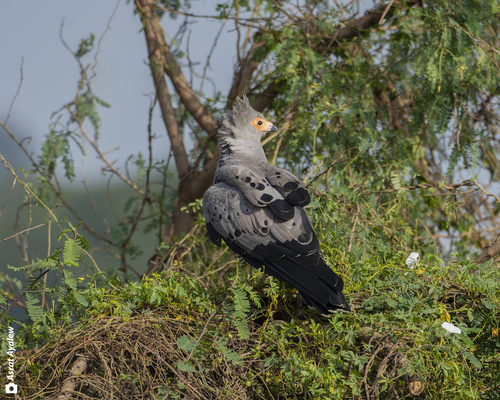
African Harrier-Hawk
Polyboroides typus
Witness the most flexible predator in the sky. Known for its 'double-jointed' legs and acrobatic 'wall-walking' hunting style, the African Harrier-Hawk is a master of suburban and wild landscapes alike.
Quick Identification
Size
Length: 60–66 cm (24–26 in); Wingspan: 120–145 cm (47–57 in); Weight: 500–950 g (1.1–2.1 lb)
Colors
Pale grey upperparts and breast; belly and thighs finely barred black and white; black flight feathers and tail with a single broad white band; bare yellow facial skin.
Key Features
- Bare yellow facial skin that flushes red when excited
- Finely barred black-and-white underparts
- Broad, rounded wings and long tail with white band
- Unique 'double-jointed' legs that bend in multiple directions
When You’ll See Them
Geographic range
Where Does the African Harrier-Hawk Live?
Native to the African continent, the African Harrier-Hawk maintains a massive resident range across almost all of sub-Saharan Africa. From the tropical belt of West and Central Africa to the temperate suburbs of South Africa, it is a common sight in countries like Kenya, Nigeria, and Ethiopia. It thrives anywhere with sufficient tree cover, avoiding only the most extreme treeless deserts.
Basemap © OpenStreetMap contributors
Behavior
The African Harrier-Hawk is a remarkably agile and specialized raptor, best known for its unique 'wall-walking' hunting technique. Unlike most birds of prey that strike from the air, this species often clambers around tree trunks and cliff faces, using its broad wings for balance while its highly flexible, double-jointed legs probe deep into crevices, weaver nests, or tree hollows to extract prey.
Generally solitary or seen in pairs, these hawks are relatively bold and have adapted well to human environments. They are frequently observed in suburban areas, where they methodically raid the nests of garden birds. Their facial skin is a fascinating biological mood ring, changing from bright yellow to deep red during courtship displays or when the bird is feeling threatened or aggressive.
EverydayEarth exclusive
Camera Tips
To capture the African Harrier-Hawk on a trail camera, focus on vertical structures rather than the ground. These birds are famous for 'clambering' up tree trunks. Mount your camera 3 to 5 meters high on a tree that hosts colonial nesters like weavers or starlings, as the Harrier-Hawk will frequently visit these locations to hunt.
In a backyard setting, aim your camera at large, textured tree trunks or palm trees. If you have palm trees with hanging fruit or fronds, these are prime spots for activity. Since they are attracted to the nests of other birds, placing a camera near a bird feeder that attracts smaller species can often result in 'fly-by' footage or high-action hunting sequences.
Because their movements are often jerky and acrobatic as they probe for food, use a high-speed trigger and a fast shutter setting to avoid motion blur. The early morning sun provides the best lighting to capture the vivid yellow of their facial skin. If you are lucky enough to catch them during the breeding season, you may even see their faces turn bright red on camera during territorial displays.
Similar Species
Species that look similar or are commonly confused with African Harrier-Hawk.
Pale Chanting Goshawk
Has bright orange-red legs and a solid grey breast, whereas the Harrier-Hawk has yellow legs and a barred belly.
Black-chested Snake Eagle
Features a distinct dark hood and chest with a bright white, unbarred belly, unlike the Harrier-Hawk's uniform grey breast and barred belly.
Frequently Asked Questions
Record African Harrier-Hawk at your habitat
Connect a camera to start building your own species record — AI identifies every visitor automatically.