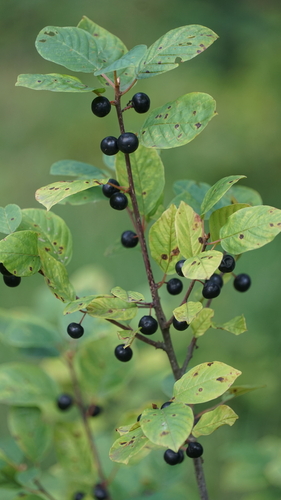
alder buckthorn
Frangula alnus
A thornless sanctuary for rare butterflies and hungry songbirds, the alder buckthorn is a master of the wetlands. Its glossy leaves and multi-colored berries make it a vibrant focal point for any backyard nature camera.
Quick Identification
Size
Height: 3-6 meters (10-20 feet); Spread: 3-5 meters (10-16 feet)
Colors
Glossy dark green leaves; berries transition from green to bright red to deep purple-black; bark is dark brown with light horizontal lenticels.
Key Features
- Entirely thornless branches unlike other buckthorns
- Glossy, oval leaves with 6-9 pairs of prominent parallel veins
- Berries of multiple colors (red and black) often present on the same twig
- Small, star-shaped greenish-white flowers appearing in leaf axils
When You’ll See Them
Loading activity data...
Behavior
Alder buckthorn is a resilient deciduous shrub known for its 'breaking' wood—a characteristic that gave it the name 'Breaking Buckthorn' due to its brittle branches. Unlike many woody plants that have a short, explosive flowering window, this species produces flowers and fruit over a long period. This staggered ripening process ensures that it provides a consistent, high-energy food source for wildlife from early summer through late autumn.
In the ecosystem, it plays a specialized role as the primary host plant for the Brimstone butterfly. Female butterflies seek out its leaves to lay eggs, and the resulting caterpillars rely exclusively on the foliage for survival. Because it lacks thorns, it is much more 'wildlife-friendly' for humans to manage than its invasive cousin, the common buckthorn, though it still spreads effectively via bird-dispersed seeds.
EverydayEarth exclusive
Camera Tips
To capture the best wildlife action on your alder buckthorn, position your camera about 3-5 feet away from a cluster of ripening berries. Because the berries transition from red to black over several weeks, this is a prime spot to catch 'frugivores' (fruit-eaters) like Cedar Waxwings, Robins, and Thrushes. Aim the camera slightly downward from a height of about 5 feet to catch birds as they land on the flexible outer branches to feed.
If you are using an AI-powered camera to track insects, focus your lens on the underside of the leaves during late spring. The alder buckthorn is the exclusive host plant for the Brimstone butterfly's caterpillars. Mount your camera on a steady stake or nearby tree trunk with a high-trigger-speed setting to catch the fast-moving pollinators—including honeybees and hoverflies—that visit the subtle, nectar-rich flowers located in the leaf axils.
Lighting is crucial when filming this species due to its namesake 'glossy' foliage. To avoid high-contrast 'white-out' from sun reflecting off the shiny leaves, angle the camera north or south so the plant is side-lit during the golden hours of morning and evening. This lighting setup highlights the deep texture of the leaf veins and the vibrant color transition of the berries, making for much clearer species identification in your footage.
During the autumn, keep your camera active as the leaves turn a brilliant, uniform yellow. This is a high-traffic period as migratory birds bulk up on the final crop of dark berries. If your camera has a time-lapse feature, setting it to take a photo every few hours during August and September creates a stunning visual diary of the berries ripening and being harvested by local wildlife. No artificial bait is needed; the berries themselves are the ultimate natural lure for your lens.
Similar Species
Species that look similar or are commonly confused with alder buckthorn.
Common Buckthorn
Has sharp thorns at the ends of twigs and finely serrated leaf edges, whereas alder buckthorn is thornless with smooth-edged leaves.
Common Dogwood
Leaves have veins that curve toward the tip rather than running parallel, and the fruit grows in flat-topped clusters rather than along the stem.
Frequently Asked Questions
Record alder buckthorn at your habitat
Connect a camera to start building your own species record — AI identifies every visitor automatically.