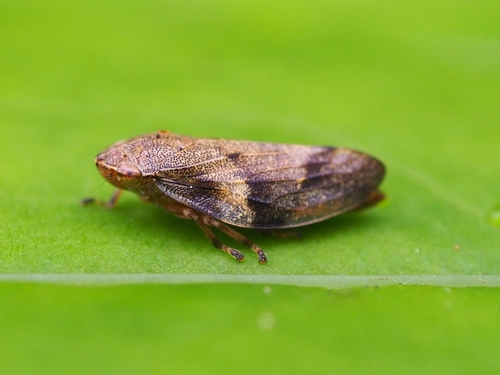
Alder Spittlebug
Aphrophora alni
A champion jumper of the garden world, the Alder Spittlebug is famous for its 'cuckoo spit' nurseries and its remarkable ability to leap to safety in a heartbeat.
Quick Identification
Size
9–10 mm (0.35–0.4 inches) in length
Colors
Mottled brown and tan body with two distinct large, pale patches on the outer edge of each wing
Key Features
- Two prominent light-colored patches on the wing margins
- Large, blunt head with wide-set eyes
- Boat-shaped body tapering to a point
- Strongly developed hind legs built for jumping
When You’ll See Them
Geographic range
Where Does the Alder Spittlebug Live?
The Alder Spittlebug is primarily native to the Palearctic region, where it is a widespread and common sight across the United Kingdom, Europe, and northern Asia reaching as far east as Japan. It thrives in temperate climates and is particularly abundant in the moist environments of Central and Western Europe. Additionally, it has been introduced to North America, where it has established stable populations in parts of the Pacific Northwest and the Northeastern United States.
Basemap © OpenStreetMap contributors
Behavior
The Alder Spittlebug is a master of survival and one of the most athletic jumpers in the insect world. While the adults are mobile and quick to leap at the slightest vibration, they spend much of their time inconspicuously feeding on plant sap. They are solitary insects, though you may find several inhabiting the same tree if the conditions are right. They are completely harmless to humans and, unlike some of their relatives, rarely cause significant damage to the ornamental plants they inhabit.
The most famous aspect of their life cycle occurs during the nymph stage. The young spittlebugs produce a frothy, soapy-looking mass of bubbles known as 'cuckoo spit.' This foam is created by the nymph pumping its body and mixing air with its excreted fluids. This bubbly fortress serves three purposes: it keeps the soft-bodied nymph moist, insulates it against temperature swings, and hides it from predators like birds and spiders who find the bitter, wet foam unappealing.
EverydayEarth exclusive
Camera Tips
To successfully capture the Alder Spittlebug on camera, you must move beyond standard trail camera setups and embrace macro photography. Because these insects are less than half an inch long, a camera with a dedicated macro lens or a high-quality 'close-up' attachment is essential. Position your camera on a small tripod or flexible mount just 4 to 10 inches away from a host branch. Look for 'cuckoo spit' in late spring as a marker for where adults will likely emerge in mid-summer. Focus on the stems of alder trees or garden shrubs like roses and hydrangeas.
Lighting is your best friend when filming small insects. Natural sunlight is great, but because spittlebugs often hide under leaves to avoid the midday heat, their environment can be dark. Use a small, battery-powered LED panel to provide soft, side-lit illumination. This will highlight the texture of their wings and the specific pale patches that identify the species. Set your camera to a fast shutter speed; even though they appear still while feeding, they can vanish in a millisecond if they decide to jump.
For the best AI detection results, use a high-resolution setting (at least 2K or 4K) and a narrow field of view. Since these bugs don't respond to traditional baits like sugar or pheromones, your 'lure' is the plant itself. Ensure the plant is well-watered and healthy, as spittlebugs are attracted to the high turgor pressure of the sap. If you are using a motion-triggered camera, set the sensitivity to maximum. Be aware that wind-blown leaves can cause false triggers at high sensitivity, so try to choose a sheltered spot or use a clip to stabilize the branch you are monitoring.
Similar Species
Species that look similar or are commonly confused with Alder Spittlebug.
Frequently Asked Questions
Record Alder Spittlebug at your habitat
Connect a camera to start building your own species record — AI identifies every visitor automatically.